
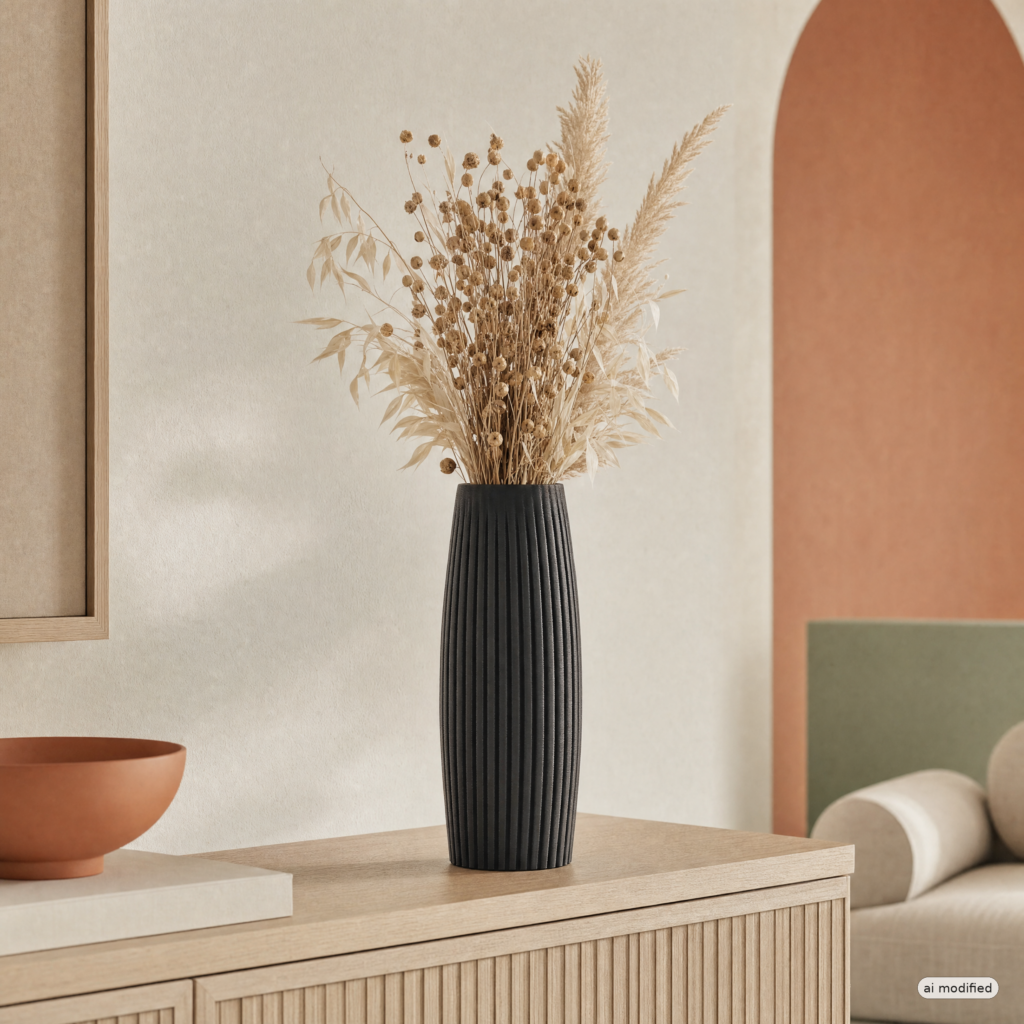
The matte black fluted vase: vertical geometry and contemporary materiality
Matte black is not the absence of color, but a silent presence. When a fluted surface meets light without reflecting it back, a dialogue is born between matter and void. A vase is not just a container: it is a miniature architecture that alters the space around it.
In the contemporary home, choosing matte black is not a statement of intent. It is a search for calm. It does not seek attention through shine, but through the purity of form and the depth of the finish. The vertical fluting adds a tactile rhythm, a texture that invites the gaze to pause.
Dark minimalism: when the void becomes the protagonist
Minimalism is not random subtraction, but conscious selection. Every element present must justify its existence in the space.
Dark-minimal is born from the encounter between the Japanese aesthetics of ma (the meaningful void) and Western geometric precision. A matte black object in a light space does not disappear: it anchors itself, creates visual gravity, offers a resting point for the eye.
The slender verticality of a cylindrical vase carries with it a sense of growth, of aspiration upward. The parallel flutes accentuate this ascending movement, while the circular base guarantees physical and emotional stability.
- Matte surfaces that absorb light instead of reflecting it
- Essential geometries with measured tactile details
- Sharp contrast between solids and voids, dark and light
- Contemporary materials with an understated presence
The strength of dark minimalism lies in its ability to enhance what it contains. A single stem of white pampas grass against a black surface becomes sculpture. Three branches of dried eucalyptus acquire monumentality.
Color palettes: orchestrating matte black
Black is not neutral: it is a color that dialogues, contrasts, amplifies. Its effectiveness depends entirely on what is next to it.
Pairing matte black with warm white creates a graphic, almost editorial contrast. It is the sharpest choice, the one that transforms every composition into a strong visual statement. It works in Nordic environments or for those seeking an art gallery aesthetic.
The combination with earth tones – burnt ochre, terracotta, sand – softens the hardness of black. A desert-like, enveloping atmosphere is born, where the vase becomes a dark anchor in a warm landscape. It suits interiors seeking a balance between rigor and warmth.
| Palette | Atmosphere | Complementary materials |
|---|---|---|
| Black + warm white | Graphic and hieratic | Bleached wood, raw linen |
| Black + burnt earths | Desert-like and enveloping | Terracotta, natural rope |
| Black + stone greys | Nordic and meditative | Concrete, sage, wool |
| Black + sand beige | Contemporary wabi-sabi | Natural wood, cotton |
Stone grey with touches of sage green brings black toward a Nordic, meditative minimalism. It is the choice for those seeking visual calm and introverted atmospheres. The fluted black vase becomes a connecting element between the coldness of stone and the softness of textiles.
The beige-taupe-black palette embraces the wabi-sabi philosophy: a celebration of imperfection, of the essential, of passing time. Here black is not violent contrast, but welcoming depth.
Materials: PLA as a contemporary choice
PLA bioplastic brings additive technology into everyday domestic life, transforming an industrial process into an emotional object.
PLA (polylactic acid) derives from renewable resources such as corn starch. It is not a random choice for a vase intended for dried flowers: it is coherence between form and function, between aesthetics and use. 3D printing makes it possible to create complex textures – such as vertical fluting – that would be difficult with traditional techniques.
The matte finish of black PLA has a particular quality: it absorbs light without creating annoying reflections, but the vertical ribs generate subtle plays of shadow. It is a material that asks to be observed up close, that rewards attention.
Bioplastic material with a natural matte finish. Ideal for compositions with dried elements. The layered texture is an integral part of the aesthetic, not a defect to hide.
The height of 18 cm and the diameter of 6.5 cm define slender proportions, suitable for single stems or small compact bouquets. It is not a vase for abundant arrangements, but for essential still lifes.
Placement and material dialogues
Every object changes the space it inhabits. The question is not “where to place it,” but “what conversation do I want to create?”.
On an entryway console, the matte black cylindrical vase becomes a silent welcome. Paired with natural wood or brushed metal, it creates a warm-cold contrast that immediately defines the character of the space.
On the bedside table, its vertical presence is reassuring without being intrusive. A single stem of white pampas grass becomes a nighttime companion, an element of meditation before sleep.
Vertical trio composition
- Selection: Three vases of decreasing heights (18 cm, 14 cm, 10 cm) create an architectural movement.
- Positioning: Arrange diagonally on a shelf or in a line on a dining table.
- Filling: Vary the botanical density – the tallest with a single stem, the shorter ones with small bunches.
On a bookshelf, among horizontal volumes, it introduces vertical rhythm. In front of an antique mirror, it creates a dialogue between eras: contemporary additive technology meeting the patina of time.
On a home office desk, the fluted vase for pampas grass offers a visual pause. It doesn't distract, but offers an anchor point when the gaze leaves the screen.
Mistakes to avoid: respect the nature of the object
Every material has a vocation. Forcing it into improper uses means betraying its essence.
PLA is specific to dry arrangements. Filling it with water for fresh flowers means ignoring both the characteristics of the material and the design intention. Dried flowers are not a fallback: they are an aesthetic choice that celebrates nature suspended in time.
Crowding the flared silhouette with too many botanical elements cancels out the purity of the form. The vase has an architectural presence that must be respected: better a single perfect stem than a chaotic bunch.
Placing it in overly colorful or chaotic settings disperses its strength. Matte black calls for breathing space, clean surfaces, controlled palettes. In an already saturated environment, it becomes one more element instead of an anchor point.
Light is a fundamental ally. In areas of total shadow, the grooves lose their interplay of reliefs. Side or overhead light is needed to bring out the three-dimensionality of the texture.
The poetics of the framed ephemeral
The true role of a matte black fluted vase is not to contain, but to frame. It offers structure to the organic disorder of dried flowers, geometry to the randomness of branches. It is the boundary between human control and natural unpredictability.
The matte finish absorbs the gaze, invites touch, creates intimacy. It is not an object that shouts its presence, but one that whispers it. Over time, it becomes a familiar presence, a visual reference point that marks the rhythm of the domestic space.
Choosing a black PLA vase with a fluted texture means embracing a contemporary aesthetic that does not renounce emotion. It is technology that becomes warmth, industrial precision that becomes a domestic gesture. It is minimalism that does not exclude, but welcomes – provided that what it welcomes is chosen with the same care with which the object itself was designed.
Q&A
What is the dark-minimal style described in the article?
Dark-minimalism emerges from the fusion of Japanese ma aesthetics (meaningful void) and Western geometric precision. It features matte surfaces that absorb light and essential geometries with measured tactile details.
What is the visual effect of vertical grooves on the vase?
Vertical grooves add a tactile rhythm and accentuate an upward movement, inviting the eye to rest on the texture. This slender verticality conveys a sense of growth and aspiration upwards.
How does matte black behave in a light space?
In a light space, a matte black object does not disappear but anchors itself, creating visual gravity and offering a resting point for the eye. Its function is to modify the surrounding space through the depth of its finish.
What atmosphere does pairing black with earth tones create?
Pairing matte black with earth tones like burnt ochre or terracotta softens the color's harshness, generating a desert-like, enveloping atmosphere. This balance is ideal for interiors seeking to reconcile rigor with warmth.
Which botanical elements does this type of vase enhance best?
The strength of dark minimalism lies in its ability to highlight what it holds, transforming simple compositions into sculptures. A single stem of white pampas grass or three branches of dried eucalyptus instantly gain monumentality.