
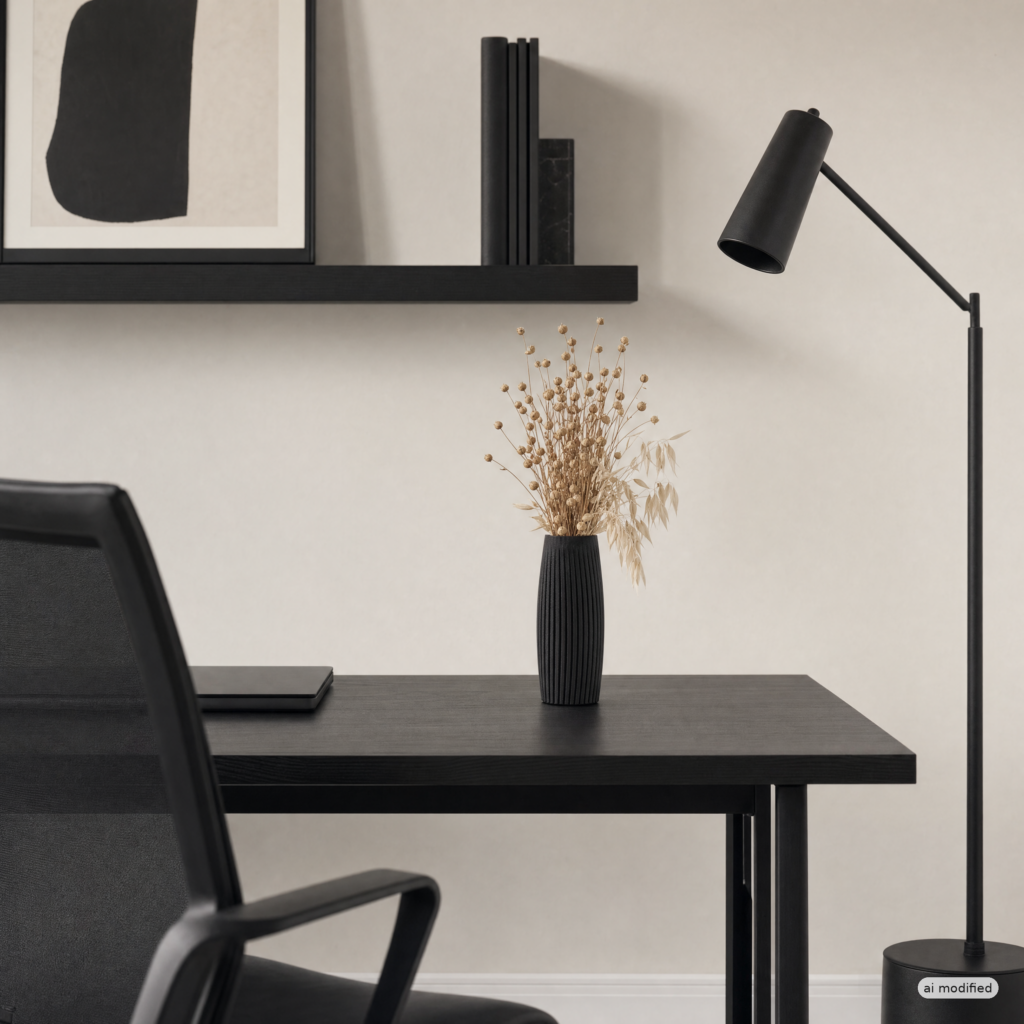
Matte Black as a Frame for the Ephemeral: The Poetics of the Fluted Vase
The void that enhances the full. The verticality that anchors itself to the ground. Matte black as a silent frame for nature suspended in time.
There is a moment when form stops being a shell and becomes architecture. It happens when the material dialogues with the void, when texture tells a story to the touch before the eye. Matte black does not decorate: it subtracts in order to enhance. The fluted vase does not shout its presence, it whispers it through the rhythm of the vertical lines that run along its 18 centimeters of height.
Vertical Geometry and Dried Nature
The slender silhouette of the vase creates a visual anchor that transforms botanical compositions into contemporary still lifes.
The vertical flutes are not ornament. They are rhythm. They create a play of shadows and lights that accentuates the three-dimensionality of the black surface, transforming natural light into a compositional element. When a single stem of white pampas grass emerges from the circular opening 6.5 centimeters in diameter, the chiaroscuro contrast reaches its maximum expression.
The PLA material with a matte finish gives the object a silent presence. It does not compete with the botanical elements; it frames them. The bioplastic becomes a discreet support for compositions of eucalyptus, grasses, and dried branches that find in the deep black their perfect counterpoint.
- Matte black absorbs light instead of reflecting it, creating a neutral backdrop
- The vertical textures of the vase dialogue with the organic lines of the stems
- The absence of water celebrates the enduring beauty of dried botanicals
Dark-Minimal: When Rigor Meets the Organic
The dark-minimal style finds in the fluted vase in black bioplastic its domestic manifesto: pure geometry that exalts the imperfection of nature.
The concept of dark-minimal is not just a chromatic matter. It is an approach that favors subtraction, essence, calibrated contrast. A black vase 18 centimeters tall on a white entryway console becomes a visual anchor point, a meditative pause in a flow of light surfaces.
The verticality of the columnar shape brings rhythm to dead corners. On a bedside table, next to a lamp with a cylindrical base and disc shade – like the Topo by Felix Pöttinger for Maytoni, which combines portability and sculptural form – the vase acts as a reassuring and intimate presence. There is no need to fill it with many elements: a single dried eucalyptus branch is enough to complete the composition.
Material Pairings and Compatible Palettes
The matte black of the vase dialogues with natural materials and earthy palettes, creating wabi-sabi harmonies or Nordic graphic contrasts.
| Matching material | Chromatic effect | Resulting atmosphere |
|---|---|---|
| Natural or bleached wood | Warm/cool contrast | Eco-contemporary |
| Black brushed metal | Textured monochromatic | Industrial chic |
| Raw stone and concrete | Tonal grey-black | Nordic minimalism |
Sand beige, dove grey and black create a wabi-sabi harmony where the imperfection of dried elements finds a home. The contrast of warm white and deep black instead creates a graphic effect, suitable for bookcases where the tall vase for pampas grass arrangements breaks the horizontal lines of stacked volumes.
Placing the vase in areas of total shadow cancels the interplay of shadows of the vertical grooves. Natural or artificial raking light is essential to reveal the three-dimensional texture.
Three-Part Compositions: The Vertical Rhythm
The rule of the trio with decreasing heights turns three vases into a domestic architectural installation.
How to create a trio composition
- Selection: Choose three vases of decreasing heights (18 cm, 15 cm, 12 cm) while keeping the same base diameter.
- Arrangement: Place them on a dining table as a centerpiece, creating an architectural movement that guides the eye.
- Fill: Insert botanical elements of different densities: pampas grass at the top, grasses in the middle, a single branch at the bottom.
This technique works particularly well on entryway consoles or deep shelves, where a depth of 6.5 centimeters allows stability without excessive bulk.
Beyond Function: A Meditative Object
Emptied of its botanical component, the vase becomes a pure sculptural element, an object of contemplation on the home office desk.
The fluted container for dried flowers and pampas it does not need to always be filled. Its flared silhouette, vertical texture, matte finish that does not create mirror-like reflections: these elements are enough to make it a standalone furnishing accessory. On a desk, next to a stack of art books, it becomes a visual pause and an anchor, a fixed point in a context of horizontal lines.
The choice of PLA – a bioplastic derived from renewable resources – adds an ethical dimension to the aesthetic gesture. It is not a secondary detail in an era that demands material awareness even in small everyday accessories.
Matte black is not the absence of color, it is silent presence. The grooves are not decoration, they are rhythm. The vase is not a container, it is a frame for the ephemeral. And in this conscious subtraction lies all the emotional power of contemporary design.
Q&A
What are the exact dimensions of the black fluted vase?
The vase has a height of 18 centimeters and a circular opening with a diameter of 6.5 centimeters. These dimensions make it ideal for single or slender arrangements.
What material is this black vase made of?
The object is produced in PLA bioplastic with a matte black finish. This material provides a silent presence that does not compete with the botanical elements placed inside.
Which floral arrangements are recommended for this vase?
The shape and matte black color are designed to enhance dried flowers, grasses, eucalyptus branches, and white pampas grass stems. The light-dark contrast maximizes visual impact.
Why are the vertical flutes important in the vase's design?
The flutes are not mere ornaments but create a rhythm of light and shadow that accentuates the surface's three-dimensionality. They interact with the organic lines of dried stems.
In which environments and styles does this vase integrate best?
It is perfect for the dark-minimal style and finds an ideal place on white entry consoles or nightstands next to sculptural lamps. Its verticality brings rhythm to dead corners.