The Beat on the Wall: When Anatomy Becomes Presence
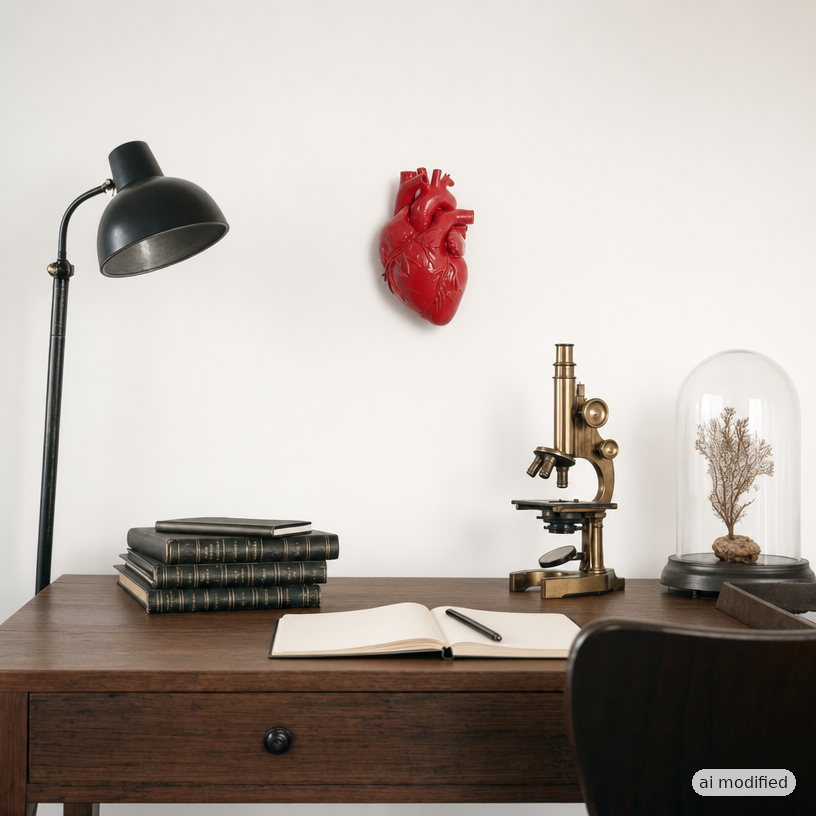
There are objects that furnish. And then there are objects that inhabit. That are not content to fill an empty space, but ask to tell something visceral, something non-negotiable. The red anatomical wall heart belongs to this second category: it is not a simple accessory, it is a sign of presence hanging on the wall.
In an era when interiors oscillate between aseptic minimalism and decorative accumulation, choosing to bring into the home the faithful representation of a vital organ means recognizing the need to feel. Deeply. Without filters.
Anatomy as Art: Beyond Biology
*The scientific reproduction of the human heart, when treated with chromatic intensity and sculptural three-dimensionality, transforms into a universal symbol of passion and emotional courage.*
Anatomical art has ancient roots, from Leonardo da Vinci's drawings to nineteenth-century medical plates. But its contemporary translation into a decorative object marks a cultural shift: biology is no longer confined to textbooks or university lecture halls. It becomes a domestic language, a tool for speaking about what pulses beneath the surface.
The anatomical heart is not romantic in the conventional sense. It has nothing of the stylized Valentine's Day shapes. It is real, complex, with its arteries, its ventricles, its imperfect and vital architecture. Bringing it into the home means accepting that love – and life itself – are never linear or decorous.
- It interrupts the chromatic silence of neutral spaces with a primordial red
- Three-dimensionality creates plays of light and shadow that change throughout the day
- It invites authentic conversations, far from pleasantries
- It warms the technological coldness of contemporary environments
Red Is Not a Color, It Is a Heartbeat
*Intense red transforms anatomical precision into pure energy: it does not decorate, it vibrates.*
There is a substantial difference between adding a generic red accent and placing a three-dimensional red anatomical heart. The first is a color choice. The second is an existential statement.
The red of flowing blood, of visceral passion, of life that does not stop. This red does not limit itself to “getting along” with the rest of the decor: it challenges it, questions it, forces it to take a stand. It works precisely because it does not seek compromises.
The plastic sculpture with a glossy finish – dimensions 22 cm in height, 15 cm in width, 6 cm in depth – is made through FDM 3D printing followed by artisanal coloring. The result is a surface that captures and reflects light, accentuating every anatomical detail: from the coronary arteries to the venae cavae, every element contributes to the perception of a living, pulsating object.
Where to Place It: Emotional Geography of the Home
*Every room interacts differently with the symbolism of the heart: from the bedroom as a love talisman to the creative studio as an energetic stimulus.*
Placement is never neutral. In the bedroom, the anatomical heart becomes a daily reminder of authentic passion, far from sugary rhetoric. In the contemporary living room, it transforms into the only warm element capable of humanizing cold, linear surfaces.
In the creative studio or home office, its presence reminds us that every project, every idea, requires heart – in the most literal sense. It is an antidote to mechanical productivity, a call to visceral dedication.
How to create an effective focal point
- Visual isolation: Place the sculpture on a free wall, preferably white or light gray, to maximize color contrast.
- Strategic lighting: Install a side LED grazing light to enhance the three-dimensional volumes and create dramatic shadows that change with the angle.
- Spatial breathing: Leave at least 50 cm of empty space around the sculpture to avoid visual competition with other objects.
Material Pairings: The Dialogue Between Opposites
*The red heart communicates through contrast: black metal, raw concrete, charred wood amplify its organic intensity.*
The most effective pairings do not seek harmony, but creative tension. Matte black metal – whether a frame, a shelf, or a structural element – creates a material contrast that enhances the organic nature of the heart. Raw concrete evokes the urban and industrial dimension, while dark or charred wood brings it back to the earth, to the raw material.
Transparent or smoked glass can lighten the visual heaviness without competing chromatically. Red or black velvet, if present in cushions or fabrics, amplifies the tactile sensory experience of the environment.
| Material | Perceived effect | Ideal setting |
|---|---|---|
| Matte black metal | Dramatic contrast | Industrial living room |
| Raw concrete | Urban tension | Contemporary loft |
| Charred wood | Organic appeal | Creative studio |
| Smoked glass | Visual lightness | Bedroom |
Mistakes to Avoid: When Intensity Becomes Chaos
*The anatomical heart requires compositional discipline: too many red elements or saturated spaces cancel out its symbolic force.*
The most common mistake is multiplying red accents. A second red cushion, a red lamp, a rug with red inserts: the result is visual confusion. It anatomical wall heart works precisely because it is the only element of that intense red in the entire space.
Also avoid excessively classic or shabby chic environments: contemporary anatomy clashes with lace and vintage patinas, risking appearing macabre rather than vital. Flat, uniform light is another enemy: 3D printing needs shadows to reveal its three-dimensional complexity.
Red is the color with the greatest visual weight: in a 20 sqm space, a red element of 22×15 cm can balance up to 3 sqm of neutral surface. Calculate the negative spaces accordingly.
Beyond Valentine's Day: Meaningful Gifts
*An anatomical heart does not celebrate an occasion, but a bond that lasts over time: it is the gift for those who do not fear emotional intensity.*
Giving a red 3D-printed anatomical heart means recognizing in the other person the ability to feel deeply. It is not a gesture for everyone: it requires a recipient who appreciates strong symbolism, who does not settle for decorative conventions.
It is the ideal gift for those who work in the medical or scientific field, but also for artists, writers, creatives who make visceral passion their driving force. For those who have gone through difficult times and come out of them with a heart still capable of beating strongly.
At the price of 60 euros, the sculpture stands as an accessible object of meaning, far from the logic of luxury but with an emotional impact that far exceeds its economic value.
The Heartbeat Continues
Hanging an anatomical heart on the wall is not a decorative gesture. It is taking a stand. It means accepting that the home is not only an aesthetic refuge, but a space of truth. That the most intense emotions deserve form, color, physical presence.
In a world that pushes toward emotional neutrality, toward spaces that neither disturb nor provoke, the red heart on the wall is an act of resistance. It reminds us that beneath every smooth surface, every composed facade, there is something that pulses. Something real, imperfect, vital.
And that it is worth showing.
Q&A
What are the dimensions of the anatomical heart sculpture?
The sculpture measures 22 cm in height, 15 cm in width, and 6 cm in depth. These dimensions make it a significant presence without occupying excessive space.
How is the red wall-mounted anatomical heart made?
The object is produced using FDM 3D printing with plastic, followed by careful hand-painting. This process ensures a glossy finish and precise anatomical details.
Why choose an anatomical heart instead of a stylized one?
The anatomical heart represents the complex and imperfect reality of life, far from conventional Valentine's Day shapes. It is an existential choice that invites authentic conversations about visceral passion.
In which settings does it work best as a focal point?
It works excellently in neutral or contemporary spaces where its primordial red interrupts the chromatic silence. Its three-dimensionality creates light and shadow plays that evolve throughout the day.
What cultural significance does anatomical art have in modern decor?
It transforms biology from a subject of study into a domestic language, symbolizing emotional courage and the need to feel deeply. It marks the transition of anatomy from a scientific manual to a universal symbol of life.