
The Dawn Mist: Building a Calm Refuge with Light Gray
Light gray is not an absence of color, but a presence of silence. When the domestic space holds too many stimuli, a visual anchor is needed that can slow the gaze and invite pause.
Rooms often accumulate. Objects, colors, information. Every surface tells something, every corner demands attention. In this context, creating zones of emotional decompression is not an aesthetic whim: it is a need for breathing room. Light gray—that shade suspended between morning mist and dry concrete—becomes a tool for building refuges of calm within everyday chaos.
Gray as Atmospheric Material
It is not about choosing a neutral color for lack of courage. Light gray is a precise decision: to build visual silence where space is needed.
Light gray works because it subtracts instead of adding. It does not compete with the other elements of the room, it does not shout to attract the eye. It recedes into the background while maintaining a discreet but constant presence, like the background sound of rain or the rhythm of someone sleeping beside you.
This shade finds its fullest expression when it meets complex forms. A simple object painted gray risks anonymity. An articulated form—organic, layered, rich in volumes—transforms gray into three-dimensional mist.
- It absorbs ambient light without aggressive reflections
- Creates visual continuity with white walls or exposed concrete
- Allows the eye to rest among chromatically intense elements
- Maintains physical presence without emotional dominance
Anatomy of Silence: When Biological Form Becomes Poetry
Anatomical representation carries with it a paradox: it is at once scientific and deeply human, rational and vulnerable. When it is emptied of the color red, an unexpected contemplative dimension emerges.
The anatomical heart is a powerful archetype. We all recognize its shape, but few have truly observed it. Reproduced on a reduced scale and deprived of its visceral connotation through gray, the organ transforms into a meditative symbol.
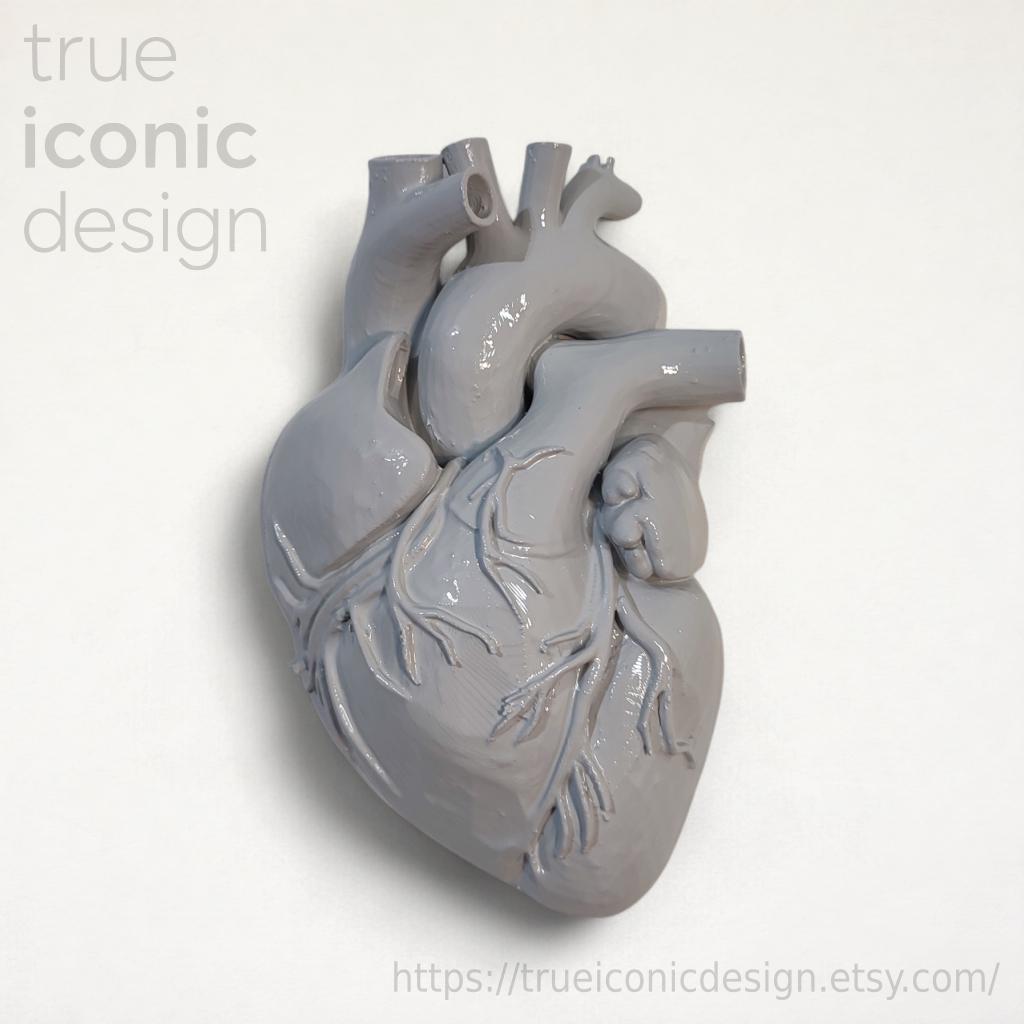
An anatomical sculpture in a light gray tone measuring 22 centimeters by 15, made of plastic with 3D printing and artisanal finishing, it occupies little physical space but a lot of emotional space. Its depth of 6 centimeters creates plays of shadow that change with natural light during the day.
The choice of light gray for an anatomical subject is not random. It eliminates the direct reference to blood, to pulsating life, to physical vulnerability. What remains is the structure: ventricles, atria, blood vessels become pure organic geometry. The result is an object that sits halfway between a medical atlas and a conceptual installation.
Building the Wall of Silence: Practical Instructions
A white wall is not automatically a calm wall. It requires design intention: the right materials, carefully planned lighting, calibrated emptiness.
How to create a visual decompression zone
- Surface preparation: Choose a wall free of shelves, paintings, switches. Microcement or matte white paint are ideal bases. Avoid decorated wallpaper or saturated colors.
- Positioning the focal element: Hang the sculpture at a height that allows close observation (150-160 cm from the floor). Leave at least 80 cm of empty space around it so as not to suffocate the object.
- Grazing lighting: Install a wall lamp with an adjustable arm or an angled ceiling spotlight. The light must come from the side to enhance the reliefs of the 3D print, creating shadows that reveal the complexity of the form.
- Atmospheric completion: At the foot of the wall, a low console in light wood (ash or birch) with a few objects: a rough ceramic vase, an open book, a dried plant. Nothing more.
Material Allies: Building Tactile Coherence
Light gray interacts better with surfaces that have a material history: weathered wood, brushed metal, wide-weave fabrics. Avoid glossy, lacquered, and overly perfect finishes.
| Material | Effect on light gray | Ideal setting |
|---|---|---|
| Natural light wood | Warms without dominating | Bedroom, study |
| Microcement | Amplifies neutrality | Minimalist living room |
| Raw linen | Introduces tactile softness | Conversation area |
| Brushed metal | Adds industrial rigor | Office, creative space |
The anatomical wall heart in gray plastic finds a natural place in contemporary environments where formal rigor and the search for human warmth coexist. Bedroom above the headboard, private study next to a low bookcase, minimalist entrance as the first element that welcomes those who enter.
Companion Palette: Monochromatic Tensions and Whispered Accents
Light gray does not ask for chromatic solitude, but discreet company. It works by subtraction: every color added must be quieter than the previous one.
The ideal palette is built in layers of decreasing intensity. Monochromatic base: anthracite gray for architectural volumes, pearl gray for fabrics, milk white for walls. Warm neutrals such as greige and taupe introduce temperature without raising their voice.
Chromatic accents must be whispered, never shouted. Dusty pink in a cushion, faded sage in a folded blanket, ash blue in a ceramic. Colors that seem to have lost saturation over time, as if faded by light.
Do not place light gray in rooms already saturated with color. In a setting with yellow walls, red sofas, and geometric rugs, the anatomical sculpture would lose its function as a “silent anchor” and become a confused element among many.
Light and Shadow: Revealing Three-Dimensionality
A 3D-printed sculpture lives on surface texture. Frontal lighting kills it, grazing light makes it breathe.
FDM 3D printing creates micro-stratifications visible up close. They are technical imperfections that become an aesthetic quality when light passes across them laterally. A spotlight positioned at 45 degrees relative to the wall transforms the uniform surface into a landscape of reliefs.
During the day, natural light entering from a side window is enough to create this effect. In the evening, a controllable artificial source is needed. Never diffuse light from above: it flattens everything. Never direct frontal light: it erases the shadows that give depth.
The gray anatomical heart in 3D printing changes appearance as the hours pass. At dawn it appears almost transparent, at noon it reveals every anatomical detail, at sunset it withdraws into a soft silhouette.
Beyond Decoration: The Heart as a Secular Memento
In spaces dedicated to well-being – psychotherapy practices, yoga rooms, home meditation corners – anatomy becomes a reminder of shared fragility.
The scientific representation of the heart carries an implicit message: we are all built the same way, all vulnerable, all mortal. No caption or explanation is needed. The form speaks for itself.
In a psychotherapy practice, hung behind the therapist's armchair, it becomes a discreet presence that reminds us of the bodily dimension of emotions. In a bedroom, above the nightstand, it is a gentle memento of the life that pulses even in sleep. In a home office, an organic counterweight to the coldness of screens.
Closing: The Slow Rhythm of Fog
Fog does not arrive suddenly. It thickens gradually, wraps around forms without erasing them, slows movement. Light gray works the same way in domestic spaces: it does not radically transform, but changes the perceptual rhythm.
Building a refuge of calm does not mean emptying the house or giving up color. It means creating points of visual pause where the gaze can rest. A wall, an object, a shade that asks for nothing in return except to be observed without haste.
The gray anatomical heart, with its 22 centimeters of height and its silent presence, becomes the guardian of this slow rhythm. It does not decorate: it anchors. It does not embellish: it calms. It stays there, on the white wall, and breathes to the rhythm of the fog at dawn.
Q&A
Why is light gray ideal for overloaded environments?
Light gray absorbs ambient light without creating harsh reflections, allowing the eye to rest between chromatically intense elements. This shade subtracts visual stimuli instead of adding them, creating a zone of emotional decompression.
What are the dimensions and material of the described anatomical sculpture?
The anatomical sculpture in light gray measures 22 by 15 centimeters with a depth of 6 centimeters. It is made of plastic via 3D printing and hand-finished to enhance shadow play.
How does the perception of an anatomical heart change if painted gray?
Stripping the anatomical heart of its red color removes the direct reference to blood and immediate physical vulnerability. This transforms the object from a visceral symbol into a meditative and contemplative element focused on pure form.
How does light gray interact with natural light throughout the day?
The sculpture's 6-centimeter depth creates dynamic shadow patterns that shift with natural light during the day. The light gray maintains a discreet yet constant presence, evolving like three-dimensional fog.
Why choose a complex shape instead of a simple gray object?
A simple object painted gray risks becoming anonymous and going unnoticed in space. An articulated, organic shape, however, transforms gray into three-dimensional fog, maintaining visual interest without emotional dominance.