
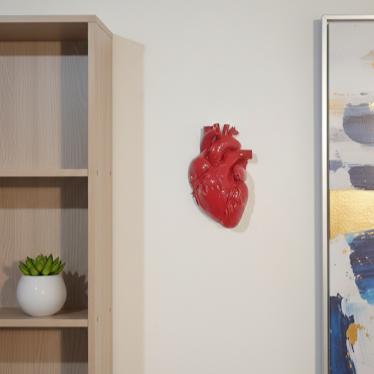
The Secular Altar: The Red Anatomical Heart as a Symbolic Hearth of the Contemporary Living Room
The contemporary living room no longer needs fireplaces to have a hearth. It needs a point that holds the gaze, that makes the room hold its breath. An element that does not heat by convection, but by presence. A secular altar where passion, life, and the courage to feel find a concrete place.
The red anatomical wall heart is this: a point that transforms a neutral surface into a place that speaks. It is not a painting. It is not a print. It is a three-dimensional sculpture that lives on the wall, that dialogues with light, that gives character to minimal spaces with a chromatic force that cannot be ignored.
The Focal Point: Building the Wall Around the Heart
Every contemporary living room needs a visual fulcrum. The red anatomical heart does not merely accompany: it holds the space together.
The first rule is to create emptiness. Intense red needs breathing room, chromatic silence around it. A white or cement-gray wall becomes the right surface. No other red decorations, no overlaps, no visual competition.
The sculpture should be positioned at the center of the main wall, at a height that naturally intercepts the gaze from a seated position. With its 22 cm height and 15 cm width, it takes up little physical space but exerts a remarkable visual weight. It is this disproportion between real size and perceived presence that makes it so effective.
- Neutral wall (white, light gray, concrete) to contrast with the red
- Ample side clearance: at least 80-100 cm on each side with no other objects
- Installation height: 140-160 cm from the floor for visual dialogue with seated viewers
- No other red accents in the room
Beneath the heart, a dark console or shelf creates a visual base. Charred wood, matte black metal, raw concrete: cold or earthy materials that balance the intensity of the red without competing. The shelf remains essential, almost empty. One or two art books, a smoked-glass object, nothing more.
Material Contrast: Cold Versus Visceral
The anatomical red comes alive when it meets surfaces that contradict it in temperature and texture.
The anatomical heart in red plastic it has a glossy finish that captures and reflects light. This brightness must be placed in dialogue with matte and rough materials. The contrast is not only chromatic: it is tactile, perceptual, emotional.
Brushed steel for the console legs. Raw concrete for a cylindrical vase. Untreated dark wood for an empty frame resting on the floor, to the side. Every cold or material element amplifies the heart's vitality through contrast.
| Ambient material | Effect on the red heart | Where to use it |
|---|---|---|
| Matte black metal | Enhances the glossy brightness | Consoles, lamps, frames |
| Raw concrete | Amplifies organic warmth | Vases, shelves, floors |
| Charred wood | Evokes earth and matter | Shelves, side tables, bases |
| Smoked glass | Lightens without competing | Decorative objects, lamps |
Fabrics also play a role. A sofa in black or anthracite gray velvet absorbs light and makes the red stand out. Cushions in raw linen or thick cotton, never satin. The goal is to create a tension between the overall matte quality of the room and the concentrated shine of the heart.
Raking Light: Sculpting Volume with Light
Without dedicated lighting, the anatomical heart loses half of its expressive power. Three-dimensionality must be revealed, not suggested.
3D printing creates precise anatomical reliefs: ventricles, arteries, coronary vessels. But these details remain invisible under flat, uniform light. A raking light source is needed, positioned to the side or from below, that grazes the surface and creates deep shadows.
Effective lighting in three steps
- Dimmable LED source: Adjustable 3000K LED strip or spotlight (warm light) so as not to cool the red.
- Side positioning: 30-40 cm to the side of the heart, at a 45° angle toward the surface.
- Intensity adjustment: The light must graze, not flood. Dimmer at 40-60% for soft but defined shadows.
Raking light transforms the three-dimensional anatomical sculpture into a living object. Shadows move as the light intensity changes, the red vibrates, details emerge and recede. It is no longer a static object: it becomes a presence that pulses.
Avoid spotlights from above or direct frontal light. They flatten the volume, erase shadows, and reduce the sculpture to a two-dimensional red patch. Three-dimensionality is the added value: it must be enhanced, not denied.
Selective Pairings: Few Objects, Maximum Impact
Around such a strong protagonist, every other element must justify its presence.
The red heart does not tolerate crowding. The wall remains essential: no gallery of paintings, no shelf loaded with knick-knacks. At most, an empty black frame resting on the floor, to the side, as if to suggest that the heart is the only work that matters.
A mirror with organic shapes, placed on a side wall, can reflect the red from different angles and multiply its perceived presence. But it must remain discreet: irregular shape, thin or absent frame, matte finish.
Do not add other red objects to the room. Red cushions, red vases, rugs with red inserts: everything creates visual cacophony. The heart must remain the only intense chromatic accent. Red is a heartbeat, not background noise.
On the low coffee table in front of the sofa: an anatomical art book, a black-and-white photography monograph, a sculptural object in black ceramic. Few elements, chosen for form and visual weight, never for color. The chromatic dialogue is already resolved: red against neutral. Everything else is form, texture, volume.
The Dramatic Monochromatic Palette: Red on a Gray Scale
The contemporary living room that houses the anatomical heart can afford a palette stripped to the bone.
White for the walls. Anthracite gray for the sofa. Black for the metal structures. The red of the heart is the only exception, the only accent in a whispered room. This monochrome is not coldness: it is expressive discipline. It is the choice to let a single color speak, but to make it resonate.
Those seeking a warmer variant can introduce earthy tones: terracotta for a cylindrical vase, rust for a blanket folded on the armchair, ochre for a framed botanical print. These are tones that dialogue with red without competing, that root it in an organic and material dimension.
Terracotta, in particular, creates an interesting bridge between the visceral red of the heart and the earth. It evokes ancient building traditions, such as those of terracotta roof tiles that characterize contemporary architectures attentive to visual warmth. It is a subtle but powerful reference: the heart is not only a symbol of passion, but also of life rooted in matter.
The Heart as an Altar: Secular Rituality in the Domestic Space
Placing a red anatomical heart in the living room is not decorating. It is declaring an intention.
The secular altar has no candles or incense. It has a symbolic object that concentrates meaning. The red 3D-printed anatomical wall heart becomes the point where the gaze returns, where thought stops. It is not background decoration: it is a presence that questions, that reminds, that celebrates.
Celebrate passion without shame. Celebrate vulnerability as strength. Celebrate the courage to show what one feels, without aestheticizing filters. In an era of sugar-coated images and performative emotions, a true anatomical heart—red, beating—is an act of radical authenticity.
The console under the heart becomes the actual altar. Here one can place objects of personal significance: a book that changed a life, an unframed photograph, a stone picked up on an important journey. Small secular talismans that dialogue with the anatomical symbol above them.
—
The contemporary living room does not need to multiply stimuli. It needs to concentrate them. The red anatomical heart is this: a symbolic hearth that warms through intensity, not physical heat. Around it an essential space is built, where every element justifies its presence and where emptiness is not absence, but breath. A secular altar for those who are not afraid to feel.
Q&A
What are the dimensions of the red anatomical heart wall piece?
The red anatomical heart measures 22 cm in height and 15 cm in width. It therefore takes up little physical space on the wall, but carries a strong visual weight thanks to its intense color and three-dimensionality.
At what height should the anatomical heart be installed on the living room wall?
The article recommends placing it 140-160 cm from the floor, so that it naturally catches the eye of someone seated. It should be placed at the center of the main wall, with ample empty space on either side.
What color should the wall be to make the red anatomical heart stand out?
The ideal wall is neutral: white, light gray, or concrete gray. The intense red needs chromatic silence around it, so other red accents or decorations that compete visually should be avoided.
With which materials should the red anatomical heart be paired in the living room?
The red plastic heart has a glossy finish that should be in dialogue with matte and rough materials. The article suggests brushed steel, raw concrete, and untreated dark wood to create tactile and perceptual contrast.
Why is the red anatomical heart described as a secular altar in the living room?
Because it replaces the fireplace as a symbolic hearth: it does not warm by convection but by presence. It is a focal point that transforms a neutral wall into a place that speaks of passion, life, and the courage to feel.