
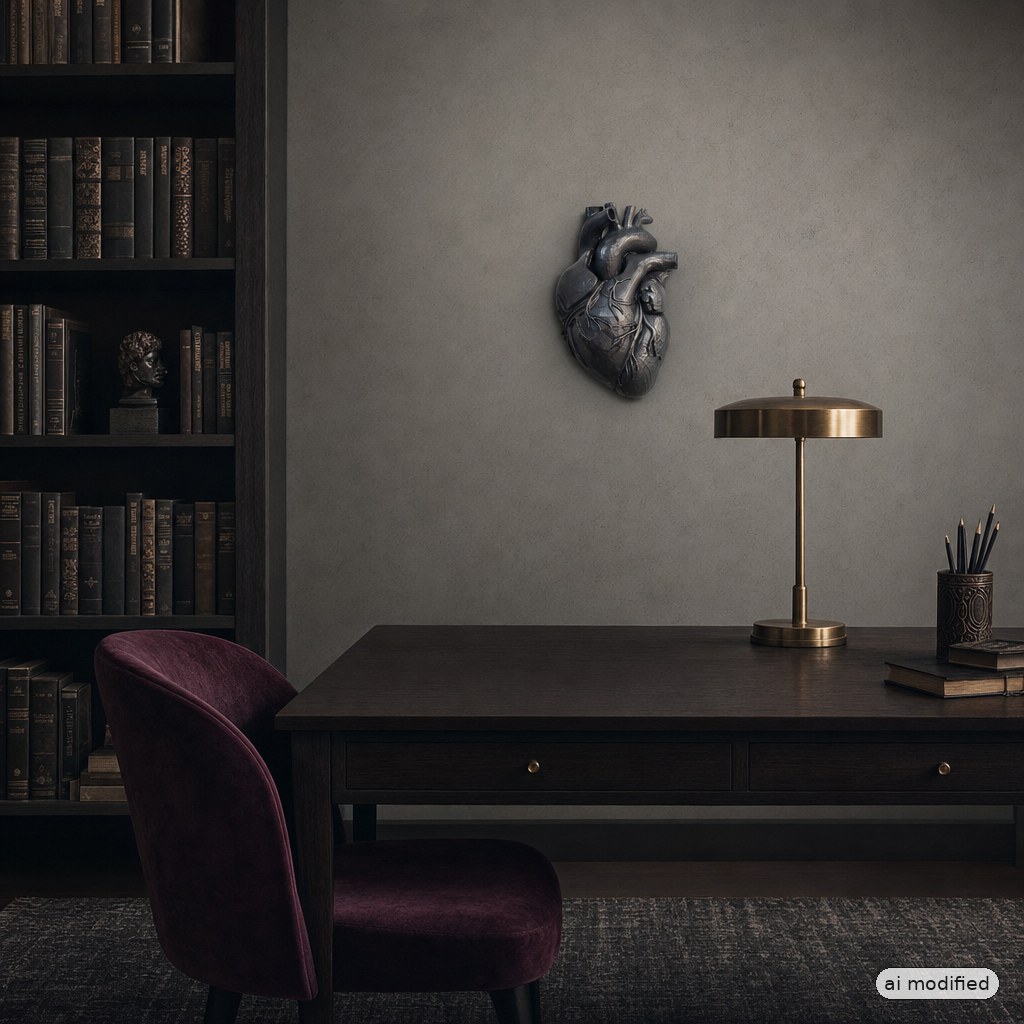
The Wall That Observes: Building a Room Around the Silence of the Graphite Heart
A wall is not decorated, it is prepared. When at the center there is an element that keeps watch, the rest of the room must be silent.
The principle is subtraction: empty the surface, calibrate the light, choose a few material companions that do not compete. The anatomical heart in dark graphite is not a picture to hang. It is an eye that observes, and the environment must be built to let it watch.
The Focal Point That Stops the Breath
A sculptural element becomes magnetic only when everything else withdraws. The wall around it must become a space of waiting.
The focal point is not imposed: it is earned. It requires visual distance, at least three meters. It requires a free wall, without interruptions. It requires light that grazes, not that reveals.
The anatomical sculpture measures 22 cm in height, 15 cm in width and 6 cm in depth. These numbers do not describe a small object: they describe a concentrated presence. The volume emerges from the wall, casts its own shadows, creates a dialogue between surface and space.
- Height: 150-160 cm from the floor, at seated eye level
- Minimum viewing distance: 3 meters to perceive the volume without fragmentation
- Free wall: at least 80 cm of empty radius around the sculpture
- Lighting: grazing from above or below, never frontal
The Light That Does Not Reveal
Dark graphite catches the grazing light and turns it into intermittent metallic reflections. Flat frontal lighting kills this effect.
An adjustable wall lamp, positioned 40 cm above or below the sculpture. Warm light 2700K, narrow beam. The beam must graze the surface, bring out the raised vascular network without erasing the shadows.
The most common mistake: a direct spotlight that flattens the volume. The graphite turns grey, opaque, without mystery. What is needed instead is a light that caresses, that reveals gradually.
In a bedroom, a bedside lamp with an articulated arm may be enough. In the study, a floor lamp with an adjustable head. In the entrance, a track with an adjustable spotlight.
Four Rooms, Four Grammars
Each room calls for a different relationship with the anatomical heart. The placement changes the meaning.
Bedroom: The Guardian of Dreams
Wall opposite the bed, slightly off-center relative to the mattress axis. The graphite anatomical sculpture becomes the last thing you see before sleeping, the first upon waking.
Pairings: dark wood headboard (wenge), raw linen sheets in cream, a burgundy velvet cushion. Nothing else on the wall. A dark red candle on the bedside table, unlit.
Study: The Anchor of Introspection
Behind the desk, visible when turning away from the workstation. A visual pause point, an invitation to reflection.
Compatible materials: brushed metal desk, black steel bookcase, dark leather chair. A brass table lamp to echo the metallic reflections of the graphite.
| Environment | Ideal height | Recommended lighting | Material companion |
|---|---|---|---|
| Bedroom | 150 cm | Adjustable bedside lamp | Dark wood + velvet |
| Study | 160 cm | Floor lamp with adjustable head | Brushed metal + leather |
| Entrance | 155 cm | Track spotlight | Smoked mirror + slate |
| Living room | 145 cm | Wall light grazing from above | Minimal sofa + plum cushions |
Entrance: The Silent Challenge
The wall facing the entrance door. Whoever enters comes face to face with the heart. A welcome that does not smile, but questions.
A narrow console cabinet beneath the sculpture, in charred wood. Above, nothing. Beside it, an off-center mirror with a black steel frame. The entrance is not filled: it is marked.
Living Room: The Only Speaking Element
Above a minimal sofa, in a central position. The wall-mounted heart in molded plastic with a graphite finish emerges as the only patch of shadow in a deliberately neutral setting.
Monochrome palette: off-white walls, pearl-grey sofa, anthracite rug. Two plum cushions for a restrained, blood-like accent. No other painting, no other decoration.
The Mistakes That Extinguish the Mystery
Dark graphite loses power in the wrong environments. Some combinations cancel out the dramatic effect.
Avoid pastel walls (pink, light blue, pale yellow): graphite becomes a foreign body with no dialogue. Avoid clutter: other objects within 50 cm extinguish its centrality. Avoid flat lighting: three-dimensionality disappears.
Do not position it too high: above 180 cm, the sculpture detaches from the emotional visual field. Do not pair it with glossy or cheap plastics: the artisanal finish is diminished.
Do not use in children's rooms or play areas: the dramatic quality feels dissonant. The anatomical heart demands maturity of gaze.
The Room That Falls Silent
Building a room around the graphite heart means accepting emptiness. The wall becomes a space of waiting, not a container to be filled.
The grey color of the sculpture, made of plastic through a process that includes 3D printing, coloring, and sketches, is not neutral: it is dense, charged with restrained power. The semi-gloss finish captures light and returns it in cold, metallic, intermittent reflections.
Prepare the wall
- Clear: Remove any item within one meter of the intended position.
- Calibrate: Test the height using a piece of cardboard of the same dimensions (22×15 cm).
- Illuminate: Position the light source and check for reflections before final fixing.
- Wait: Leave the wall empty for 24 hours and observe it from different angles.
The sculpture is suitable for the bedroom, kitchen and dining room, living room, creative space, and office. Its contemporary style allows it to be placed in different settings: gothic modern, industrial chic, dark minimalist, eclectic.
But in every case, the rule is one: the room must be silent so that the heart can observe. It is not decoration. It is presence.
Q&A
At what height should the anatomical graphite heart be hung?
The recommended height is between 150 and 160 cm from the floor, that is, at the eye level of a seated person. This way the sculpture remains in dialogue with whoever observes it without dominating the room.
How much distance is needed to appreciate the volume of the sculpture?
At least three meters of visual distance are needed to perceive the volume without fragmentation. It is also good to leave about 80 cm of free wall around the work, so the focal point can breathe.
What is the right lighting for the graphite heart?
The ideal light is grazing, from above or below, with a warm temperature around 2700K and a narrow beam. An adjustable lamp placed about 40 cm above or below the sculpture brings out the vascular network in relief.
Why avoid a frontal spotlight on the sculpture?
Flat frontal light flattens the volume and makes the graphite gray and opaque, erasing the mystery of the work. Dark graphite captures grazing light better, turning it into intermittent metallic reflections.
What are the dimensions of the anatomical graphite heart?
The sculpture measures 22 cm in height, 15 cm in width and 6 cm in depth. It is not a small object, but a concentrated presence that casts its own shadows on the wall.