
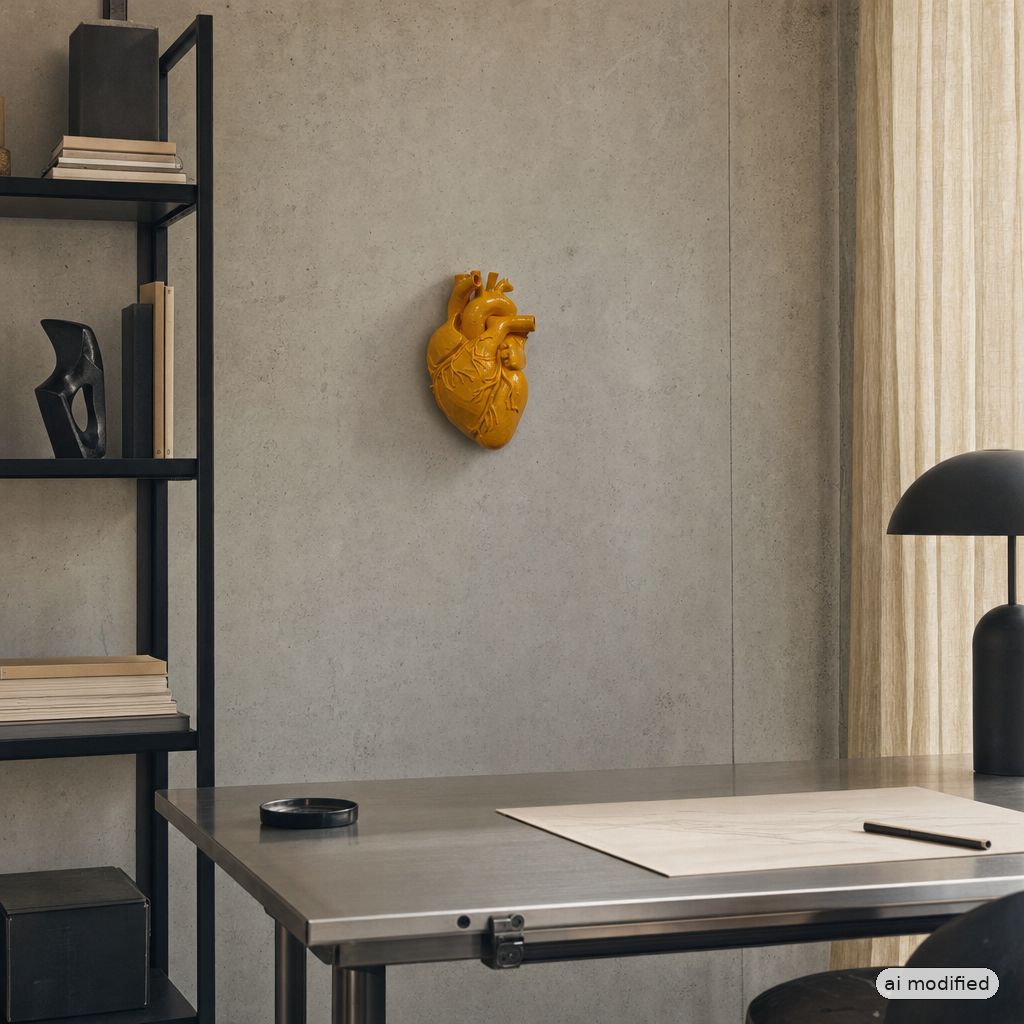
Ochre Yellow and Midnight Blue: The Chromatic Pair That Ignites the Anatomical Heart
When a warm color meets a cool background, the space breathes differently. Ochre yellow, a sunny and earthy tone, finds its counterpoint in midnight blue: a dialogue of opposites that gives volume, depth, and presence. This chromatic pair is not just an aesthetic pairing: it is a field of visual energy that transforms a neutral wall into a point of character.
The warm-cool contrast works because it creates tension without conflict. Ochre yellow radiates, midnight blue absorbs. One advances, the other recedes. A dynamic balance is born that captures the gaze and holds it.
The contrast that enhances sculptural volume
Midnight blue is not just a background: it is a frame that amplifies the three-dimensionality and emotional charge of the object standing out against it.
When a wall sculpture in ochre yellow emerges from a midnight blue surface, something precise happens. The volume stands out forcefully. Shadows become deeper, the reliefs more evident. Grazing light, necessary to enhance every sculptural detail, finds a natural ally in the chromatic contrast.
- Midnight blue creates perceptual depth, making the yellow “advance”
- The warm-cool contrast amplifies the perception of relief
- Ochre maintains its solar charge without competing with other warm colors
The anatomical heart in ochre yellow, with its raised coronary vessels and glossy surface that catches reflections, becomes the focal point that holds the midnight blue wall together. The branching coronary arteries, reminiscent of roots or rivers, create a design that the contrast makes even more legible. Every curve of the ventricles, every anatomical detail emerges with sharpness.
Balancing proportions: full wall or accent wall
There’s no need to paint the entire room: a single midnight blue wall is enough to create the desired effect.
The rule is simple: midnight blue works best as an accent wall, not as a dominant color. A single painted wall creates the necessary contrast without weighing down the space. The other surfaces remain neutral: off-white, light gray, sand.
How to compose the wall
- Choose the wall: Prefer surfaces well lit by natural or raking artificial light.
- Position the object: Center the sculpture or move it slightly off-axis for a less symmetrical effect.
- Illuminate with precision: Use directional spotlights to create shadows that enhance the relief.
The wall-mounted anatomical heart in ochre-yellow plastic It measures 22 cm in height by 15 cm in width, with a depth of 6 cm that gives it a three-dimensional presence. These proportions make it ideal as a focal point on a medium-sized wall, without the need for other decorative elements competing for attention.
Surrounding materials: maintaining balance
Dark wood, brushed metal, and raw linen are the materials that dialogue with the ochre-blue pairing without dulling it.
Dark wood echoes the depth of midnight blue and adds material warmth. A console in walnut or stained oak, positioned under the blue wall, creates visual continuity. Brushed metal introduces a contemporary, cool element that balances the emotional charge of the yellow.
| Material | Effect | Where to use it |
|---|---|---|
| Dark wood | Material warmth | Console, frames, shelves |
| Brushed metal | Cool contrast | Lamps, structural details |
| Raw linen | Cozy softness | Cushions, curtains, rugs |
Raw linen, in natural or sand tones, softens the whole without taking strength away from the main contrast. Avoid overly glossy or synthetic fabrics: the natural texture keeps the atmosphere warm and human.
Lighting as the third color
Grazing light transforms the wall into a field of vital energy, where shadows and reflections become part of the composition.
Lighting is the element that brings the contrast to life. Frontal light flattens, grazing light enhances. Position dimmable LED spotlights about 30-40 cm from the wall, directed downward or sideways. The glossy surface of the yellow sculptural heart captures the reflections and returns them as points of light on the ventricles and vessels.
Choose light bulbs with a temperature of 2700-3000K (warm white) to enhance the ochre yellow. Cooler temperatures dull the hue and cancel the contrast with midnight blue.
Natural light must be managed carefully. If the midnight blue wall receives direct light during the middle hours of the day, the color may appear lighter and less deep. It is better to choose a wall exposed to indirect or diffused light.
Mistakes to avoid and possible variations
Crowding the wall, using cool lighting, or pairing pastel colors are the most common mistakes that cancel the contrast.
The first mistake is overloading the wall with other decorative elements. The anatomical heart has a strong presence: let the space around it breathe. At most two or three small objects, in neutral or metallic tones, so as not to compete.
The second mistake is the wrong lighting. Blue or cool white lights dull the ochre and make the midnight blue look gray. Color temperature is essential.
The third mistake is pairing pastel or overly soft colors. Ochre yellow has a full intensity: powder pinks, dusty blues, or mint greens water it down. If you want to soften it, use sand, ivory, or dove gray.
Possible variations: instead of midnight blue, try a deep sage green or an anthracite gray. The warm-cool contrast remains, but the atmosphere changes. Green brings nature, gray brings urban essentiality.
Closing: a gesture of light that transforms
A midnight blue wall with an ochre yellow anatomical heart is not decoration: it is presence. It is energy that pulses, solar passion that radiates, anatomy that becomes matter and meaning. The warm-cool contrast creates a space where the gaze finds rest and stimulation together, where light becomes gesture and gesture becomes atmosphere.
Q&A
Why does ochre yellow work well on a midnight blue wall?
Ochre yellow is a warm, earthy color, while midnight blue is cold and deep: the warm-cold contrast creates visual tension without conflict. Blue recedes and absorbs, ochre advances and radiates, bringing out the volume of the sculpture. The result is a dynamic balance that captures the eye.
Is it better to paint the whole room or just one wall in midnight blue?
Midnight blue works best as an accent wall, that is, on a single wall, not as the dominant color of the entire room. A midnight blue surface creates the necessary contrast without weighing down the space. The other walls are best left neutral, such as off-white, light gray, or sand.
How do you light the ochre yellow anatomical heart against a midnight blue background?
You need raking light, capable of enhancing the sculptural details of the heart. Directional spotlights are ideal because they create deep shadows that make the reliefs of the coronary vessels and ventricles more evident. The chromatic contrast with midnight blue further amplifies the perception of volume.
Which details of the anatomical heart stand out best against midnight blue?
The contrast makes the raised coronary vessels, which resemble roots or rivers, and every curve of the ventricles more legible. The glossy surface of the heart catches reflections that, against the dark background, are even more evident. Midnight blue creates perceptual depth and makes the ochre yellow advance.
Where should the anatomical heart be placed on the midnight blue wall?
You can center the sculpture for a symmetrical effect, or shift it slightly off-axis for a less rigid result. It is important to choose a wall well lit by natural or raking artificial light. The heart measures 22 cm in height by 15 cm in width, so it should be placed on a sufficiently large surface.