
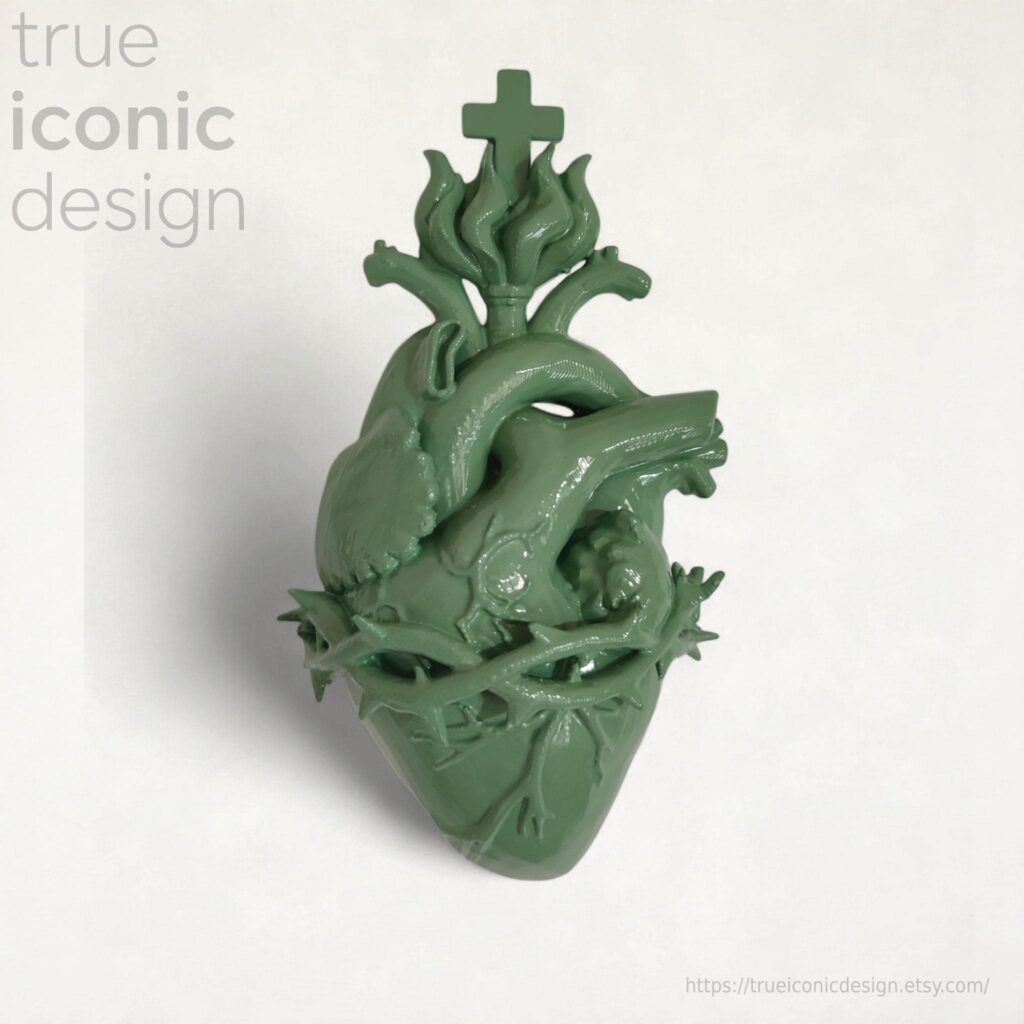
The Sacred Heart in Sage Green: Anatomy of Gratitude on Raw Lime Walls
A contemporary ex-voto that translates devotion into domestic language, building secular altars through material contrasts, raking light, and a few chosen objects.
There is a moment when gratitude asks to become visible. Not with words, not with passing gestures. With a sign that remains. The tradition of ex-votos — offerings given for grace received — is born from this ancient need: to give form to relief, to healing, to the return to life. Today that same urgency finds space in homes, but with a different language. More discreet, more material, capable of dialoguing with raw surfaces and essential volumes.
The anatomical heart surmounted by a cross and flames, encircled by a crown of thorns, is no longer merely a devotional icon. It becomes the visual focal point of a wall. A silent manifesto of vulnerability safely exposed. An emotional bridge between sacred past and rational present.
Building the domestic altar: contrasts and surfaces
The strength of a contemporary ex-voto emerges from the dialogue with materials that enhance its silent sacredness through tactile and chromatic contrasts.
The glossy paint of the Sacred Heart ex-voto in sage green calls for a wall that responds with roughness. Raw lime, untreated microcement, plaster deliberately left imperfect: these are the surfaces that bring out the preciousness of the object without slipping into a patinated effect.
Sage green — desaturated, contemplative — naturally pairs with earthy palettes: cream, sand, oxidized bronze. Avoid optical white and sugary pastels that cancel the emotional depth of the piece. Instead, seek warm, matte tones that embrace the sculpture's sheen without competing with it.
- Sage green + cream + oxidized bronze for intimate atmospheres
- Sage green + ash gray + copper for cooler, more monastic settings
- Sage green + terracotta + ochre for dialogues with Catholic folk art
Contrast is not only chromatic. It is also material. Next to the smooth surface of painted PLA, add charred dark wood, brushed brass that slowly oxidizes, natural fabrics such as unbleached raw linen. These materials carry with them time, transformation, imperfection — exactly what is needed to balance the geometric perfection of 3D printing.
Lighting: bringing out the anatomy
Grazing light turns the anatomical reliefs into a visual narrative, while frontal light flattens and cancels the three-dimensionality of the sculpture.
The most common mistake is lighting the heart with flat light from above or from the front. The anatomical details — vessels, ventricles, thorns — disappear, the crown loses depth, the flames flatten. Instead, you need side light, possibly from below, that caresses the volumes, creating long, dramatic shadows.
A recessed spotlight positioned at the base of the wall, aimed upward, transforms the piece into a theatrical presence. If recessing is not possible, a floor lamp with an adjustable arm does the same job. The important thing is that the light source remains discreet, almost invisible, leaving the object as the protagonist.
How to light the ex voto
- Positioning: Install a side light source, preferably from below, about 30-40 cm from the wall.
- Intensity: Choose a warm light (2700-3000K) with a dimmer to adjust the atmosphere according to the time of day.
- Direction: Aim the beam upward so that it grazes tangentially along the surface of the sculpture, enhancing reliefs and shadows.
Height and visual weight of the cross
The cross at the top requires vertical space above it: ignoring this detail means visually compressing the entire composition.
The heart measures 15 cm in height, 9 cm in width, and 4 cm in depth. Compact dimensions, but the visual weight of the cross at the top calls for breathing room. Placing the piece too close to the ceiling or an overhanging shelf creates a sense of oppression.
The ideal height is at eye level: between 140 and 160 cm from the floor, depending on the setting. In the bedroom, above the headboard, it can be slightly higher. In the entryway, on a free wall, it stays lower to welcome those who enter. In any case, leave at least 40-50 cm of empty wall above the cross.
Composing the altar: few objects, strong presence
Visual clutter is the enemy of the ex voto: every added element must have an emotional or symbolic reason, never decorative.
Around the wall-mounted Sacred Heart build an essential composition. A tall candlestick in matte brass, a dry olive or oak branch, a small bowl in rough ceramic to hold stones or petals. Nothing more.
If the heart is hung above a console or a low piece of furniture, arrange the objects asymmetrically: the candlestick on the left, the branch on the right, the bowl slightly set back. Leave empty spaces. Emptiness is part of the composition, not a mistake to fill.
| Environment | Suggested combinations | Resulting atmosphere |
|---|---|---|
| Bedroom | Raw linen, brass candlestick, dry branch | Intimate, protective, silent |
| Entrance | Dark wood console, antiqued mirror, ceramic bowl | Welcoming, blessing, sober |
| Creative space | Open bookcase, philosophical texts, anatomical objects | Reflective, visceral, intellectual |
Avoid paintings, prints, or other decorations on the same wall. The heart must remain alone, an icon that stops the gaze and invites pause.
Sage green as a common thread
The color of the sculpture is not a detail: it is the starting point for weaving chromatic relationships with fabrics, ceramics, and metals present in the room.
The sage green of the heart can be repeated in small touches: a velvet cushion on the armchair, a folded blanket at the foot of the bed, a succulent in a terracotta pot on the shelf. Do not seek the perfect match, but the discreet echo.
Alongside the green, introduce oxidized bronze: handles, frames, lamps. Copper that slowly patinas. Natural or charred oak wood. Materials that age with dignity, that bear the mark of time — exactly as the ex-voto bears the mark of grace received.
Avoid shiny, glamorous, or excessively reflective surfaces in the immediate vicinity of the heart. The sacredness of the object requires material restraint, not visual competition.
Where to place the heart: rooms and functions
Each room offers a different key to interpretation: from the welcoming blessing of the entrance to the nighttime protection of the bedroom, to the visceral reflection of the study.
In the entryway, the heart becomes a point of silent welcome. Hung above a minimal dark wood console, accompanied by a key bowl and a small antiqued mirror, it creates a daily ritual of passage between outside and inside.
In bedroom, above the headboard, it takes on the function of a protective talisman. The anatomical vulnerability of the heart dialogues with the vulnerability of sleep, creating a cozy, intimate atmosphere. Here sage green ties in with natural linen bedding, with the sand and cream tones of the walls.
In creative space or study, placed in an open bookcase among volumes of anatomy, philosophy, and art, the heart becomes a manifesto of visceral passion. Remember that thought is born from the body, that the intellect cannot be separated from emotion.
Closing: the gesture that remains
There is something profoundly human in wanting to fix gratitude to a wall. In giving weight, form, and color to a feeling that would otherwise vanish. The contemporary ex-voto does not ask for religious faith, but for emotional availability. It asks us to accept that the home can also be a place of recollection, that a wall can become an altar without the need for liturgies.
The anatomical heart in sage green, with its crown of thorns and its stylized flames, brings within the domestic walls a piece of that ancient tradition. It does so with a contemporary language, with materials of the present, but with the same urgency as always: to make visible what has been received, to preserve the memory of healing, to transform pain into a sign that remains.
Q&A
What is the Sacred Heart ex voto in sage green?
It is a contemporary wall ex voto: an anatomical heart topped with a cross and flames, wrapped in a crown of thorns, with a glossy sage green finish. It translates the devotional tradition of ex votos into a domestic and tactile language.
On which walls does the sage green Sacred Heart look best?
The article recommends rough surfaces such as raw lime, untreated microcement, or deliberately imperfect plaster. These enhance the preciousness of the object without slipping into a patinated effect.
Which colors pair with the sage green of the ex voto heart?
The suggested palettes are sage green with cream and oxidized bronze, with ash gray and copper, or with terracotta and ochre. It is best to avoid optical white and sugary pastels that cancel the emotional depth of the piece.
Which materials should accompany the sacred heart in painted PLA?
Dark charred wood, brushed brass that slowly oxidizes, and natural fabrics such as unbleached raw linen are recommended. These materials bring time and imperfection, balancing the geometric perfection of 3D printing.
How should the Sacred Heart wall ex voto be lit?
The article indicates grazing light as the ideal choice, because it transforms the anatomical reliefs into a visual narrative. Frontal or flat overhead light, on the other hand, flattens and cancels the three-dimensionality of the sculpture.