
The Heart in the Waiting Room: Silver as the Skin of Creative Waiting
There is a moment, before the idea takes shape, when the mind remains suspended. Fingers on the keyboard, gaze wandering, breath slowing. In that white space between thought and action, a fixed point is needed. Not a motivational manifesto, not a framed quote. Something is needed that pulses without moving, that reflects without speaking.
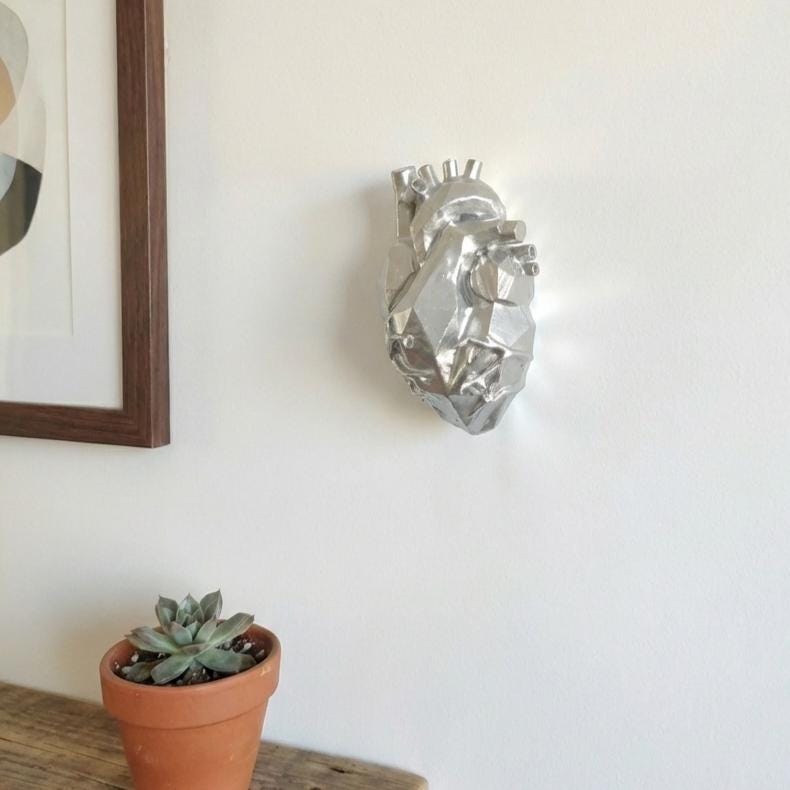
A light concrete wall. A cold spotlight cutting through the air from above. And at the center, an anatomical silver heart that captures the light and gives it back like a silent promise.
The Surface That Thinks
In creative workspaces, objects do not decorate: they mark time. The silver anatomical heart becomes a visual metronome, a presence that marks the rhythm between concentration and pause.
Sabine Marcelis, in her first museum exhibition Light and Color at the Museum für Gestaltung in Zurich, she built an entire narrative around the way light and material interact. Her Lokum glass tables, stacked against a curved wall, show how the same object changes nature depending on the angle and lighting. It is not decoration: it is architecture of attention.
The polished silver anatomical heart It works with the same logic. Its reflective finish is not an aesthetic quirk: it is an active surface. It captures ambient light, breaks it down, and reflects it back. In the morning, with raking natural light, it almost becomes a mirror. In the afternoon, under artificial lighting, it becomes more matte, more present. In the evening, with a directional spotlight, it bursts into sharp contrasts between bright areas and deep shadows.
- It reflects light without heating it: it keeps the environment mentally “cold” and clear-headed
- It changes appearance with the lighting: it visually marks the passing of working hours
- It contrasts with screens and matte surfaces: it offers a three-dimensional vanishing point
A mental posture, not style
The silver anatomical heart is not hung for decoration. It is placed to establish a dialogue: between the organ that pumps life and the mind that produces ideas.
The ideal placement is not random. Above the desk, slightly offset from the center, so that your gaze meets it when you look up from the screen. Or opposite, on the wall you look at during breaks, when your back rests against the backrest and your brain seeks a visual foothold to start again.
Height matters: 15 centimeters of sculpture, with a depth of 7 centimeters that sets it off from the wall. It is not a flat picture. It is a volume that emerges, that breathes space. Its compact dimensions (11 centimeters wide) make it suitable also for small walls, niches, and spaces carved out between shelves and monitors.
The metallic silver color is not neutral: it is a deliberate choice. It rejects the warmth of copper, the preciousness of gold, the softness of pink. It chooses precision, industrial metal, the surface that does not absorb but reflects. It is the color of technology becoming art, of biology becoming mechanism.
| Lighting | Effect on silver | Time of day |
|---|---|---|
| Natural side lighting | Soft reflections, almost liquid surface | Morning |
| Diffused artificial light | Matte presence, sculptural volume | Afternoon |
| Cool directional spotlight | Sharp contrasts, dramatic shadows | Evening/night |
Anatomy and anticipation
The anatomical heart is not a romantic symbol. It is a physiological reminder: creative work requires an organ that pumps, that resists, that does not stop.
Marcelis speaks of his objects as “moments for reflection,” spaces in which to pause and look before moving on. His approach is not chronological but experiential: each piece shows a different way of working with light and color. Likewise, the anatomical wall heart with a silver finish does not tell a linear story. It offers a visual resting point, a place where the gaze can rest while the mind reorders.
Its stylized anatomical form — ventricles, atria, branching vessels — is not medical decoration. It is an acknowledgment of a truth: behind every idea there is a body that sustains it. Behind every project, a heartbeat that keeps time. The metallic silver transforms this biological truth into a technological presence, into polished armor for those who create every day.
The compatible environments are not random: bedroom, living room, kitchen, office, creative space. But it is in the studio, in the workspace, that the heart finds its strongest reason for being. There it becomes a personal totem, a presence that does not judge but accompanies. There the silver reflects not only light, but also anticipation — that necessary suspension before the idea materializes.
The silver anatomical heart needs room to breathe. Avoid crowded walls or overly dense compositions. It works best as a single focal point, surrounded by empty space or by materials that enhance its contrast: raw concrete, dark wood, smoked glass.
The Silent Heartbeat
The waiting room is not a physical place. It is that mental state in which one remains before the leap, before the decision, before the hand draws the first line. The silver anatomical heart inhabits that space. It does not fill it, it marks it. It does not decorate it, it punctuates it.
An object that pulses without moving. A surface that reflects without speaking. A heartbeat that continues, silent, while everything else waits to take shape.
Q&A
Why choose an anatomical silver heart for a creative studio?
Because its reflective surface doesn't decorate but marks the visual rhythm: it captures ambient light and returns it differently depending on the time of day, marking the passage of working time. It also keeps the environment mentally 'cool' and lucid, contrasting screens and matte surfaces.
How does the appearance of the silver heart change with lighting?
In the morning, with grazing natural light, it becomes almost a mirror; in the afternoon, under artificial light, it becomes more matte and present; in the evening, with a directional spotlight, it explodes into sharp contrasts between bright areas and deep shadows.
Where is it best to place the anatomical silver heart in the studio?
Above the desk, slightly offset from the center, so that the gaze meets it when looking up from the screen. Or in front, on the wall observed during breaks, to offer a visual anchor before starting again.
What are the dimensions of the anatomical silver heart for the wall?
It is a sculpture 15 centimeters tall with a depth of 7 centimeters, which lifts it off the wall. It is not a flat picture but a volume that emerges and breathes space.
How does the silver heart stand out from common wall decor?
It is not a motivational poster or a framed quote: it is an object that pulses without moving and reflects without speaking. Its reflective finish is an active surface that breaks down and bounces back light, becoming a visual metronome between concentration and pause.