
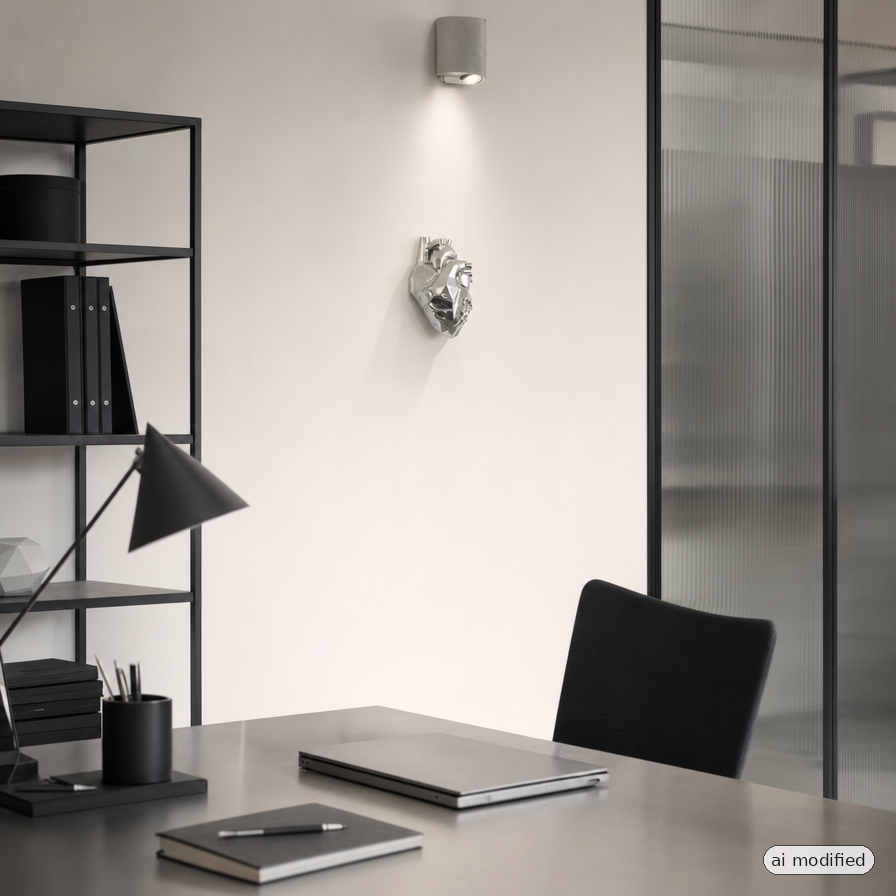
The Entrance as a Buffer Zone: The Silver Heart Between Threshold and Reflection
The entrance is not just a corridor. It is the point where you leave the world outside and reconnect with yourself. A transitional space that asks for a sign, not an object: something that holds the gaze for an instant, before crossing the threshold.
The anatomical silver heart lives exactly in this tension. It is not passive decoration: it is a presence that transforms an anonymous hallway into a buffer zone between outside and inside.
The Focal Point as a Daily Ritual
The entrance asks for an object that is the last memory before going out and the first encounter upon returning. A presence that marks the passage.
The anatomical sculpture works as a visual anchor point in an otherwise neutral space. Its low-poly geometry, made of flat faces and sharp edges, captures light dynamically. Every angle returns a different reflection, a variation ranging from brilliant white to dark gray.
Place it near the passage point. The ideal height is eye level: between 150 and 170 centimeters from the floor. That way it becomes impossible to ignore.
- Neutral wall: cool white or pearl gray to enhance the silver reflections
- Directional lighting: cool-light spotlight from bottom to top
- Empty space: at least 80 cm of breathing room around the sculpture
Cool Light and Sharp Shadows
Lighting transforms a static sculpture into a dynamic element. Cool light enhances the metal, while warm light dulls it.
An LED spotlight with a color temperature of 5000-6000K, positioned on the floor or on a low track, casts geometric shadows on the wall. The polygonal faces of the anatomical heart with a silver finish become an interplay of volumes that changes with the time of day.
Avoid incandescent lamps or warm LEDs. Yellow light flattens the silver finish and cancels the mirror effect, which is the heart of the visual impact.
Lighting scheme for metal sculptures
- Positioning: Spotlight 60-80 cm from the base of the wall, tilted 45° upward.
- Intensity: 300-500 lumens to create contrast without dazzling.
- Verification: Shadows must be sharp, not soft. If they are soft, the light is too diffuse.
Transition Materials: Stone, Steel, Dark Wood
The dialogue between cold and warm materials defines the character of the space. Silver demands decisive counterpoints, not half-measures.
The glossy surface of the sculpture dialogues with materials that have weight and physical presence. Polished stone such as slate or basalt creates a geological anchor. Brushed steel amplifies the industrial character. Dark charred wood or wengé introduces an organic note without slipping into traditional domestic warmth.
In a project like Casa Ani, where local stone and black metal coexist in balance between old and new, a wall-mounted metal heart would find a natural placement at the intersection between the stone volume and the contemporary metal one. Not as a quotation, but as an emotional bridge between ancient matter and futuristic form.
| Material | Visual effect | Compatibility |
|---|---|---|
| Polished stone | Weight and permanence | High |
| Brushed steel | Industrial consistency | Maximum |
| Dark wood | Warm/cool contrast | High |
| Soft fabrics | Tactile conflict | None |
Dimensions and Technical Details
The anatomical heart measures 15 cm in height, 11 cm in width and 7 cm in depth. Compact dimensions that allow it to be placed even in narrow entrances without overwhelming the space.
The process involves FDM 3D printing followed by artisanal coloring and enameling. The uniform silver finish hides the layered nature of the support and brings the tactile perception to that of cast metal. The horizontal micro-striations, consistent with the layer printing technique, are visible only from close up.
The silver color belongs to the family of contemporary metallic grays. It is neither chrome-plated nor mirrored, but maintains a high reflectivity that varies with the viewing angle.
Errors to Avoid in Composition
Visual clutter is the main enemy. An entryway with too many sculptures, paintings, or 3D objects cancels the impact of the focal point. The anatomical sculpture requires breathing room and empty space around it to assert itself.
Avoid placing it too high or outside the direct field of view. It is an object that calls for close observation, not distant contemplation. And never pair it with bouclé fabrics or light-colored velvet: softness cancels the technological tension that is its reason for being.
Versatility in Contemporary Environments
Although designed for the entryway, the sculpture adapts to many contexts. Creative studio, minimalist living room, urban loft-style bedroom. Wherever a visual break is needed in otherwise overly symmetrical or predictable spaces.
Its chromatic neutrality allows it to interact with both cool palettes (white, gray, black) and controlled warm accents such as burgundy red or dark wood. But always in balanced compositions, never chaotic.
The Heart as a Threshold Totem
Coming home and encountering a silver anatomical heart is not a random decorative gesture. It is choosing to experience technology not as cold mechanics, but as an extension of the human. It is accepting that the vulnerability of flesh and the coldness of metal can coexist in the same symbol.
The entrance thus becomes more than a corridor. It becomes the place where every day you remember that even emotions can have a precise geometry, a gleaming armor, a shape that withstands time.
Q&A
At what height should the silver anatomical heart be positioned in the entryway?
The ideal height is at eye level, between 150 and 170 centimeters from the floor. This way the sculpture becomes a focal point impossible to ignore in the passage. It should be placed near the transit point, with at least 80 cm of empty space around it.
What lighting enhances the silver finish of the anatomical heart?
A cold-light LED spotlight is needed, with a color temperature between 5000 and 6000K, positioned on the floor or on a low track. The recommended intensity is 300-500 lumens, tilted 45 degrees upward at 60-80 cm from the base. Warm or incandescent light flattens the silver and cancels the mirroring effect.
How should the shadows cast by the sculpture look?
The shadows should be sharp and geometric, not blurred. If they appear soft, it means the light is too diffused and should be made more directional. The polygonal faces of the low-poly heart thus project a play of volumes that changes with the hours of the day.
What color should the wall behind the silver heart be?
The ideal wall is neutral: cool white or pearl gray. These tones enhance the silver reflections of the sculpture and bring out its variations from brilliant white to dark gray. Warm colors that dampen the metallic effect should be avoided.
Why is the silver anatomical heart suitable for the entryway?
The entryway is a transitional space that calls for a statement, not just a decorative object. The anatomical heart works as a visual anchor point in an otherwise neutral environment, marking the ritual of leaving and returning. Its low-poly geometry captures light dynamically from every angle.