
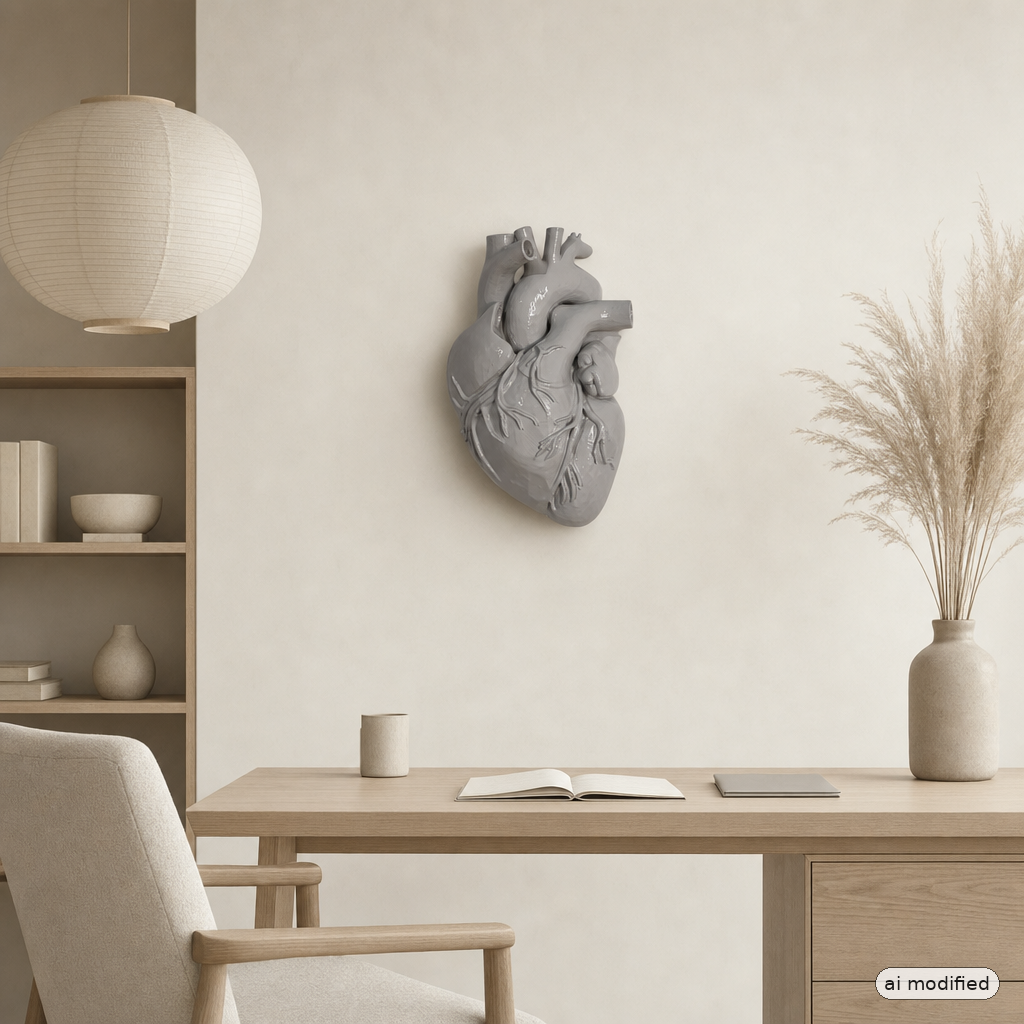
Gray as the Sound of Silence: When the Anatomical Heart Becomes Mural Poetry
There is a moment of the day when the noise stops. Dawn, when the light is still uncertain and the outlines of things become soft. It is in that pause, in that balance between night and day, that the power of visual silence resides: not the absence of something, but a calm presence.
Bringing this silence into the home means choosing objects that do not ask for attention, but receive it. Shapes that do not distract, but anchor the gaze. The anatomical heart in light gray belongs to this family of presences: sculptures that transform the wall into a point of quiet.
Anatomy as Emotional Language
The human heart, stripped of its vital red, becomes pure form. Science meets vulnerability in a balance that speaks without words.
Anatomy is not only scientific rigor. When the shape of the human heart is reproduced in its real structure – ventricles, arteries, vessels – it becomes a universal symbol of inner life. Not the stylized heart of playing cards, but the real organ, with its organic complexity.
Removing the color red means removing urgency. The structure remains, the essence. Light gray acts as an emotional filter: it transforms passion into contemplation, the heartbeat into breath.
- Neutralizes without erasing: it maintains presence without dominating the space
- Creates visual bridges between different elements in a room
- Absorbs and reflects natural light according to the time of day
The power of monochrome in the home
A single color, rendered in all its shades, builds more complex atmospheres than any variegated palette.
Monochrome is not monotony. It is visual discipline. When you choose to decorate with neutral tones – from anthracite gray to milk white – every variation in tone becomes meaningful. A light gray sculpture on a greige wall creates a subtle dialogue, made of reflections and shadows.
The anatomical heart in light gray made with FDM 3D printing and artisan finishing, it measures approximately 22 cm in height and 15 cm in width. Its smooth, compact surface, with a matte or slightly satin finish, captures light differently throughout the day.
The printed and painted plastic maintains total chromatic coherence. Every anatomical detail – from the coronary arteries to the great upper vessels – is wrapped in the same soft gray. There are no interruptions, no internal contrasts. Only pure form.
Illuminating silence: light and three-dimensionality
3D printing creates volumes that exist only when light brushes them. The right lighting transforms a sculpture into a living presence.
A relief sculpture lives on shadows. Frontal, flat light kills it, canceling all depth. Raking light – the kind that comes from the side, perhaps from a wall lamp or an oblique window – enhances every curve, every sculpted anatomical detail.
How to position the light
- Choose a side light source: an adjustable-arm lamp or adjustable wall sconce mounted at a distance of 30-40 cm.
- Adjust the angle: the light should graze the surface, not hit it perpendicularly.
- Observe the shadows: the ventricles and vessels should cast soft shadows on the wall behind.
The light reflections on the curve of the aorta and on the ventricles reveal the three-dimensionality of the piece. The texture of the FDM print, covered by the paint, still lets a slight tactility show through that the light can enhance.
Where the gray heart lives
Not all spaces can accommodate silence. Empty walls, air, visual breathing room are needed.
The light grey anatomical heart It asks for solitude. Not in the sense of isolation, but of space around it. A crowded wall suffocates it, a chaotic gallery silences its voice.
The ideal environments are those that seek calm: the bedroom in the meditation area, the private study next to a low bookshelf, the minimalist living room where every object is chosen with intention. Even the contemporary entrance, if clean and linear, can become its home.
| Environment | Recommended pairing | Achieved effect |
|---|---|---|
| Bedroom | Natural light wood, raw linen | Introspective quiet |
| Creative study | Microcement, brushed metal | Soft rigor |
| Wellness area | Acid-etched glass, raw concrete | Temporal suspension |
Compatible materials are those that share the same philosophy: light wood such as ash or birch, matte surfaces such as resins and microcement, wide-weave fabrics. Brushed metal – satin brass or cold steel – creates graphic contrasts without violence.
Mistakes to avoid
Minimalism is unforgiving. Every element out of place becomes noise.
Placing a grey anatomical sculpture in an overly colorful room is like shouting in a library. Light grey loses its function as “silence”; it becomes invisible or, worse, out of place.
Avoid crowding the wall with other decorative elements. The anatomical heart needs visual air to breathe. An empty wall is not a waste: it is a choice.
Even the wrong lighting can ruin everything. Flat light cancels the shadows of the 3D print, turning the sculpture into a two-dimensional silhouette. And romantic or kitschy pairings – cupids, red flowers, overly sweet decorations – clash with anatomical rigor. Anatomy demands formal respect.
Modern Wabi-Sabi: imperfection as a value
Every 3D-printed and hand-finished piece carries small variations. Not defects, but signatures of uniqueness.
FDM 3D printing is a technique that layers plastic material to create solid volumes. Artisanal post-production – sanding, painting, finishing – adds the human touch. The result is never identical to the previous one. Each anatomical heart sculpture is unique due to artisanal variations.
This controlled imperfection fits perfectly into the modern Wabi-Sabi philosophy: accepting transience, celebrating authenticity, finding beauty in the essential. Light gray, with its neutral and nuanced nature, amplifies this concept.
The heart as a domestic totem
A totem is not an idol. It is an emotional reference point, an anchor that holds the soul steady amid everyday chaos.
Hanging an anatomical heart on the wall means choosing a symbol of silent vitality. Not the frenetic heartbeat of the city, but the steady, reassuring rhythm of life that continues. It is the biological engine that keeps us standing, represented without drama or emphasis.
In a Nordic or Scandinavian space, where white and natural wood dominate, the light gray of the heart becomes a bridge between warmth and coldness. In a Japandi environment – the meeting of Nordic and Japanese aesthetics – the anatomical sculpture dialogues with rough ceramics and dried plants. Read also