
The Guardian of the Shadow: When the Anatomical Heart Becomes a Secular Altar
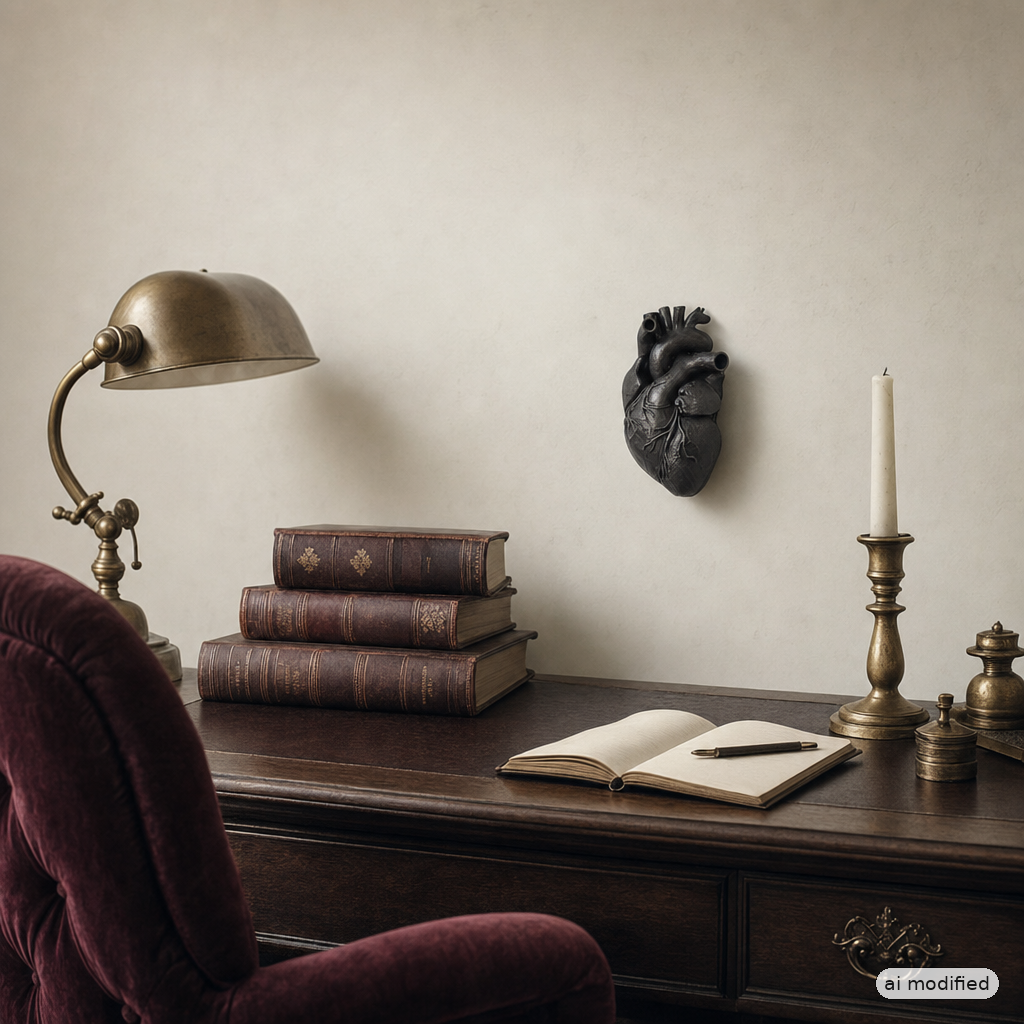
In a room, the presence of an object can change the air. It is not decoration, it is a fixed point. The anatomical heart in dark graphite is born for this: it does not fill, it attracts the gaze and asks for silence.
Its anatomy is precise: ventricles, arched aorta, raised coronary network. Science becomes language. The graphite color envelops the form, like the night that protects the vulnerable.
The Power of Restrained Power
*Dark graphite does not shout: it whispers. It is the color of those who do not need to show themselves to be heard.*
This deep gray tone carries a silent energy. It is not the absolute black that closes every dialogue, nor the neutral gray that disappears. It is a dense middle ground, charged with presence.
The semi-gloss finish captures grazing light and returns it as cold metallic reflections. These changing glimmers transform the surface into a landscape that changes with the hours of the day. In the morning it appears more severe, in the evening it softens in the half-shadows.
- It creates depth without visually weighing down the space
- Dialogue with noble materials without competing
- Protects the intimacy of spaces dedicated to introspection
Anatomy as a Metaphor of the Soul
*When medical science meets art, the vital organ becomes an aesthetic totem.*
The real shape of the heart carries a double meaning. Anatomical rationality on one side, passion and hidden life on the other.
In graphite, the symbol becomes complex. It is not the romantic red heart, nor the sacred one. It is the recognition that depth also dwells in shadow.
The striated texture, a trace of 3D printing, reminds us that perfection is built layer by layer.
Where to Place the Guardian
*Not all spaces deserve a guardian. It takes an environment that can welcome mystery without fearing it.*
The anatomical heart in graphite finds its ideal placement in environments dedicated to concentration and intimacy. The home study, where thought needs to anchor itself to a fixed point. The dark romantic bedroom, where it becomes a silent guardian of dreams. The entrance, for those who wish to welcome guests with a note of elegant challenge.
How to position it effectively
- Height: At eye level, never too high. It must remain in the emotional visual field.
- Lighting: Side grazing light to enhance the relief and metallic reflections.
- Context: Free wall or at the center of a controlled composition, never crowded by too many nearby elements.
The sculpture measures 22 cm in height, 15 cm in width, and 6 cm in depth. This compact size makes it suitable even for small spaces, but its visual presence exceeds physical dimensions thanks to the three-dimensional volume and the shadows it projects on the wall.
Material and Chromatic Dialogues
*The dark graphite asks for equally refined travel companions: materials that enhance its mystery without diminishing it.*
The brushed metal – aged brass or black steel – creates a dialogue between cold surfaces that reflect each other. The dark charred wood, such as wenge or ebony, offers a tactile contrast between plastic hardness and organic warmth. Velvet, with its deep softness, softens the anatomical severity without erasing it.
On the chromatic front, the dark graphite wall heart lends itself to various strategies. The monochromatic – grays and blacks in multiple shades – amplifies the dramatic effect. Burgundy or plum red evokes blood in a sophisticated way, without falling into the literal. Antique gold or copper illuminate the graphite with precious and warm touches.
| Pairing | Effect | Ideal setting |
|---|---|---|
| Petrol green | Cold and mysterious contrast | Study, library |
| Off-white | Makes the heart stand out as the only shadow spot | Minimal bedroom |
| Burgundy | Sophisticated blood-red appeal | Dark romantic living room |
Errors to Avoid
*Even the most powerful guardian can lose its voice if placed in the wrong context.*
Overly bright environments or those saturated with pastel colors cancel the mystery of graphite. Direct and continuous natural light flattens metallic reflections, turning the sculpture into a simple gray object.
Avoid children's rooms or play areas: the anatomical drama would be dissonant. The dark heart demands visual and emotional maturity.
Cluttering the wall with too many nearby decorative elements extinguishes its role as protagonist. This anatomical wall heart needs breathing room, empty space around it that amplifies its presence. Better a nearly bare wall with a single powerful focal point than a cluttered gallery.
The Contemporary Secular Altar
*In an era that has abandoned traditional sacred symbols, new altars are born for new devotions.*
The anatomical heart in graphite can become the center of a composition reminiscent of ex voto, but translated into a secular and contemporary key. Paired with dark red or black candles, ancient philosophy books, small collectibles – a skull, a tarot deck, a raw stone – it creates an altar dedicated to introspection.
It is not superstition, but recognition of the human need for visual reference points for interiority. In an increasingly fluid and multifunctional domestic space, these dedicated corners offer an emotional anchor.
The sculpture is made of plastic with 3D printing and artisanal finishing, hand-applied coloring. This process gives each piece a slight uniqueness in reflections and shades, while maintaining the anatomical precision of the digital model.
The Mystery That Protects
In the end, the guardian of the shadow is not just a decorative object. It is a daily reminder that depth also dwells in darkness, that the
Q&A
What are the visual features of the graphite anatomical heart?
The object features precise anatomy with ventricles, an arched aorta, and a raised coronary network. The semi-gloss finish creates cold metallic reflections that shift with the light.
Why is graphite color ideal for this type of decoration?
Dark graphite offers a dense midpoint between black and gray, creating depth without weighing down the space. It protects the intimacy of environments dedicated to introspection.
In which home environments is it recommended to place this sculpture?
Ideal placement includes a home office for concentration, a dark romantic-style bedroom, or an entryway for an elegant welcome.
How should the anatomical heart be lit to enhance its details?
Side grazing light is necessary to highlight the relief of the anatomy and the metallic reflections of the striated surface.
At what height should the sculpture be installed on the wall?
It should be positioned at eye level to remain within the emotional field of view, avoiding placement too high relative to the observer.