
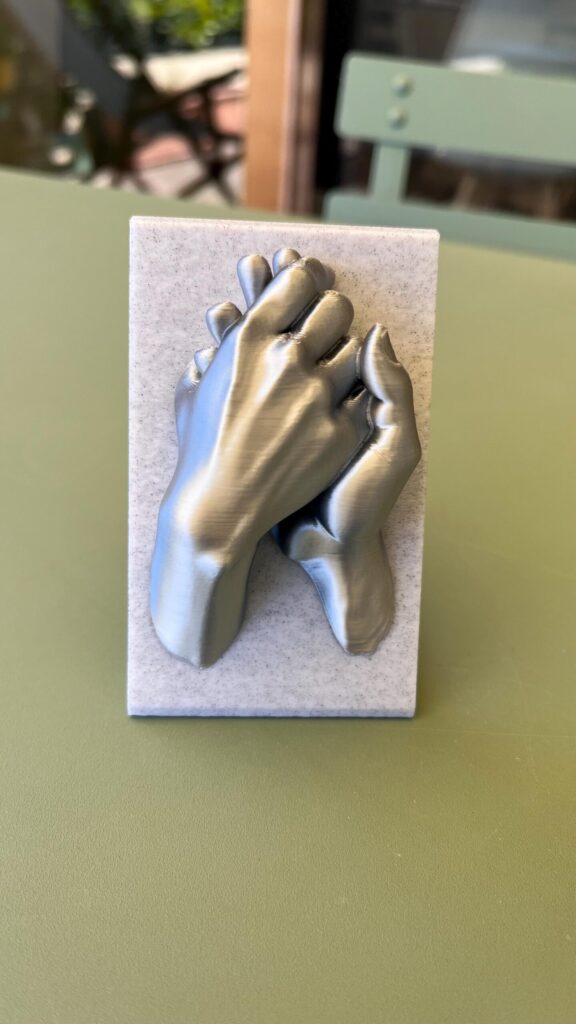
The Quiet Corner: How a Small Bas-Relief Transforms a Desk Corner into a Self-Care Ritual
In contemporary homes, where every centimeter counts, the desk is often a battleground between function and the desire for beauty. Among keyboards, notebooks, and cables, finding space for emotional breathing room seems an impossible luxury. Yet 20 square centimeters and a carefully chosen object are enough to transform a work corner into a point of visual and emotional anchoring.
Delimiting the space: the first act of care
Before placing any decorative element, you need to define a symbolic perimeter that separates work from intimacy.
A light wood tray, a natural oak desk pad, or a simple beech board are enough to create a visual threshold. Wood naturally dialogues with cold, technological surfaces, offering a tactile contrast that the eye perceives as reassuring.
The ideal size? Between 25 and 35 centimeters wide, enough to hold three elements without crowding: a book, a succulent, and a vertical symbolic object.
How to build the quiet corner
- Choose the base: Light wood or marble to create material continuity with the central object.
- Position at a distance: 20-30 cm from the main workstation, not at the center of the gaze but in the peripheral area.
- Add side lighting: A small warm LED lamp at 45 degrees enhances the metallic finishes and creates depth.
The focal point: when the symbol becomes an anchor
A vertical object with strong chromatic contrast attracts the eye without distracting, offering a meditative pause in moments of fatigue.
The mini table sculpture “True Love” responds exactly to this function. With its height of 8.6 cm and width of about 5 cm, it takes up minimal space but creates a significant visual impact thanks to the contrast between the base with marble-effect pigment and the silver-colored hands.
The subject – two intertwined hands – transforms an ephemeral gesture into a permanent form. It is not decoration for its own sake, but a catalyst of meaning: it recalls connection, mutual care, the silent affection that sustains even on the most work-focused days.
Made of PLA bioplastic through 3D printing, this bas-relief statuette with intertwined hands carries with it the trace of the creative process: the horizontal striations visible on the silver surface are not imperfections, but the digital signature of its layered birth.
Geometry of light: enhancing the silver detail
The metallic finish of the hands requires a side light source to reveal volumes and depth.
Positioning the sculpture at a 45-degree rotation relative to the window or desk lamp creates plays of light that change throughout the day. In the morning, natural light enhances the contrast with the light-colored base; in the evening, a warm LED lamp softens the silver reflections.
Avoid direct heat sources: PLA is sensitive to high temperatures. No nearby radiators, no halogen lamps within a few centimeters.
The depth of about 6 cm requires a stable support base. Avoid surfaces that are too small or slanted: the integrated rear foot ensures balance only on horizontal surfaces.
Material combinations: building visual coherence
The dialogue between different materials creates perceptual richness without chaos, provided a restricted palette is respected.
Next to the contemporary bas-relief True Love, a succulent plant in a terracotta pot introduces an organic element that contrasts with the geometry of the sculpture. A book with a dusty gray or soft blue cover creates chromatic continuity without repetition.
Cold metal – a decorative steel paper clip, a small aluminum pen holder – engages in dialogue with the silver hands, amplifying the stylistic coherence. Real marble or granite, if present in other corners of the room, creates a visual continuum with the stone-effect base of the sculpture.
| Material | Perceptual effect | Recommended distance |
|---|---|---|
| Light wood | Warm/cool contrast | Direct base |
| Transparent glass | Enhances silver finish | 10-15 cm |
| Raw linen fabric | Tactile balance | Vertical background |
Limited palette: the power of neutral tones
In small spaces, every bright color draws attention away from the focal point. Mineral tones, on the other hand, amplify the presence of the symbolic object.
Dusty grays, ivory, soft blues: these shades do not compete with silver but enhance it through contrast. A sage-green notebook, a natural wax candle, a bleached wood frame complete the composition without overloading it.
Absolutely avoid fluorescent colors, bright reds, or complex graphic patterns in the surrounding area. The’decorative object with a love symbol needs visual breathing room to express its emotional charge.
- Placing the sculpture on unstable bases or bases that are too small relative to its depth
- Placing overly bright colors alongside it that break the mineral elegance
- Place it in chaotic contexts where detail is canceled out
- Expose it to direct heat sources (radiators, halogen lamps)
The daily ritual: turning the break into a mindful gesture
A well-positioned symbolic object is not just decoration, but an invitation to a micro-practice of presence.
In moments of tiredness, the gaze falls naturally on the quiet corner. Intertwined hands remind us that work is at the service of relationships, not the other way around. That sculpted gesture becomes a tactile reminder: even in frenzy, there is room for care.
Some place a handwritten note next to the sculpture, others a black-and-white photograph. The important thing is to keep it simple: three elements at most, never more.
Beyond the desk: replicating the model in other corners
The same compositional logic works on bedside tables, entryway consoles, or living room shelves.
On a bedside table, the mini sculpture becomes a wish for solid relationships before sleep. At the entrance, on a narrow console, it offers the first message of welcome to those who enter. In the living room, placed among books and photo frames on a shelf, it gives an emotional signature to an otherwise functional space.
The key is always the same: delimit, choose a few coherent elements, leave breathing room. In small apartments, multiplying these emotional micro-spaces creates a network of anchor points that transforms the home into a mindful refuge.
—
A corner of quiet does not require square meters, but intention. Twenty centimeters of well-cared-for surface are worth more than an entire wall crowded without rhyme or reason. And when the chosen object carries with it a universal symbol – like two hands clasping – that minimal space becomes a portal to something greater: the memory of what truly matters.
Q&A
How much space does the True Love bas-relief take up on the desk?
The True Love bas-relief measures approximately 8.6 cm in height and 5 cm in width, occupying roughly 20 cm². It is designed to fit into a desk corner without crowding the workspace.
What material is the True Love bas-relief made of?
It is made of PLA bioplastic through 3D printing. The horizontal striations visible on the silver surface are the trace of the layered printing process, not a defect.
How should the bas-relief be positioned to enhance the silver finish of the hands?
A side light source is needed, for example a small warm LED lamp oriented at 45 degrees. The grazing light enhances the volumes of the intertwined hands and creates depth on the metallic finish.
What elements should be paired with the bas-relief in the quiet corner?
A base in light wood, marble, or oak is recommended for material continuity, plus two supporting elements such as a book and a succulent. The ideal base measures between 25 and 35 cm in width.
At what distance should the bas-relief be positioned from the workstation?
It should be placed 20-30 cm from the main workstation, in the peripheral area of the gaze and not in the center. This way it serves as a visual anchor point without distracting during work.