
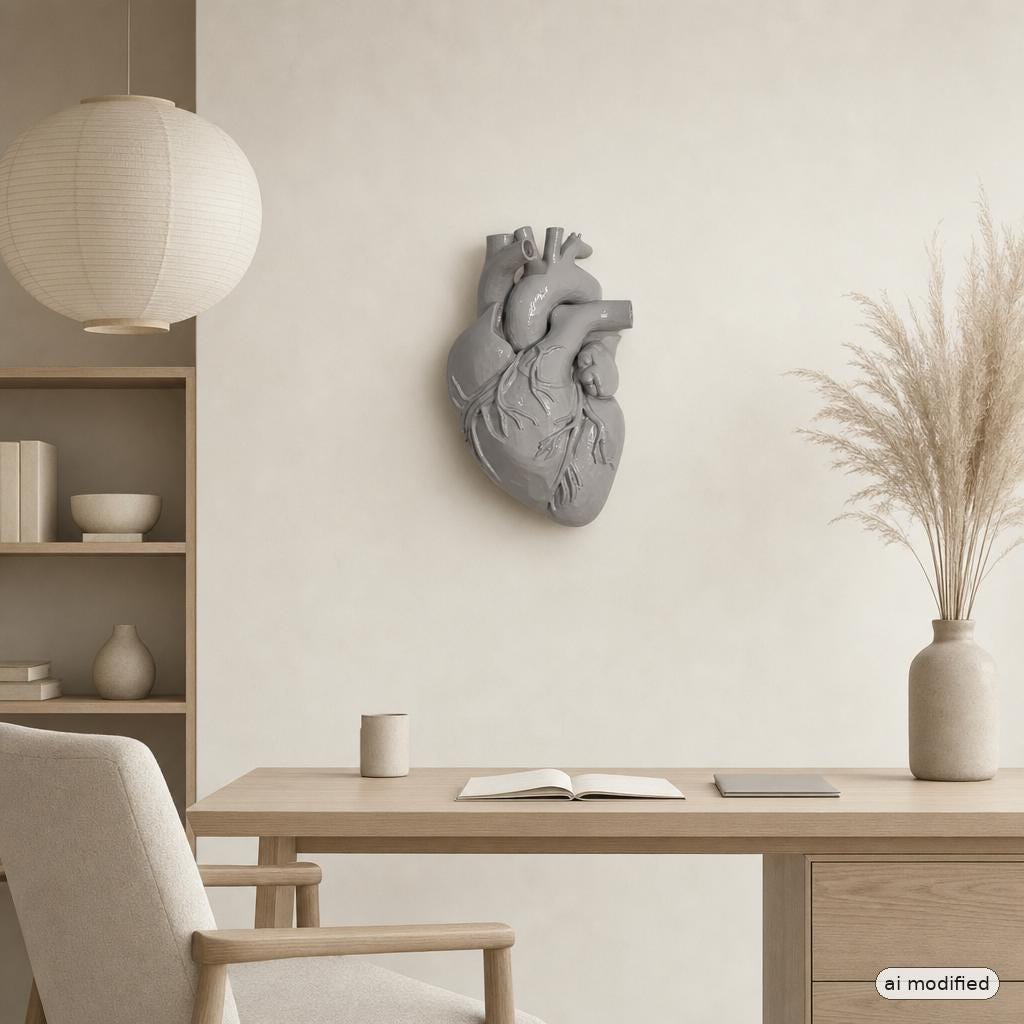
The Suspended Heart: Creating a Corner of Pause in Just a Few Square Meters
In contemporary apartments, where every square meter is contested among different functions, carving out an authentic space for rest becomes an act of resistance. You do not need an entire room to create a ritual of pause: a corner, a free wall, a focal point that invites you to stop is enough. The anatomical heart in light gray, suspended in solitude, transforms an unused corner into a daily micro-refuge.
The Reading Corner as Ritual, Not as Furniture
A reading corner is not an armchair with a lamp beside it. It is a space defined by intention, where every element helps slow down time.
The difference between a functional corner and a ritual space lies in the ability to create invisible boundaries. In a small apartment, where functions overlap, you need an element that marks the territory without physically occupying it. A wall sculpture, positioned at a height that engages with those who sit, becomes the visual anchor that defines the space without walls.
Light gray works as chromatic silence. It does not compete with the surrounding colors, nor does it draw attention with violent contrasts. It simply exists. And in existing with that profound neutrality, it creates a field of calm around itself.
- Vertical focal point that does not occupy floor space
- Grazing side lighting, never frontal
- Rug that marks the perimeter without physical barriers
- Low seating and a single plant element
- Deliberate emptiness: no decorative clutter
The Wall as an Emotional Boundary
In a small space, the wall is not just a support: it is the backdrop that determines the atmosphere of the entire corner.
When horizontal space is limited, verticality becomes a resource. A free wall, even just a few square meters, can accommodate a light gray anatomical wall heart which, given its compact dimensions (15 cm wide, 22 cm high, 6 cm deep), does not intrude but defines.
The sculpture should be hung in solitude. No painting beside it, no shelf beneath it, no symmetrical composition. The emptiness around it is not absence: it is breathing space. The anatomical form, with its ventricles, atria and raised coronary branches, emerges from the wall with a volume that creates its own shadows. These shadows change with the light of day, making the sculpture a living element.
The mounting height is crucial. Not at the geometric center of the wall, but at a height that corresponds to the gaze of someone seated: about 120-130 cm from the floor. In this way the heart becomes a silent interlocutor, not a decoration to be admired while standing.
Raking Light: Enhancing Texture Without Intruding
Frontal light flattens. Raking light sculpts.
In a corner of just a few square meters, lighting cannot be generic. You need a side light source, positioned at 45 degrees to the wall, that grazes the surface of the sculpture without striking it directly. A floor lamp with an adjustable arm or a wall lamp with an adjustable beam are ideal solutions.
The glossy finish of the plastic material, which gives soft reflections similar to lacquered ceramic, captures light differently depending on the angle. The thin layer lines, traces of 3D printing with artisanal coloring, become part of the perceived texture only when light grazes them from the side.
How to light a wall sculpture in a small space
- Position the light source: at 45 degrees to the wall, never head-on or too low.
- Adjust the intensity: warm light (2700–3000K), dimmable to adapt to the times of day.
- Check the shadows: shadows must enhance the volume, not create muddled patches on the wall.
Delimiting Without Enclosing: Rug, Seating, Void
The rug is not decoration: it is the soft boundary that says “another rhythm begins here”.
In a small apartment, where living room, study and relaxation area coexist, the rug becomes the most effective tool for delimiting the relaxation corner. A rug in raw linen, compact in size (120×180 cm), defines the perimeter without physical barriers. The wide weave and neutral color engage in dialogue with the light grey of the sculpture.
The seating must be low: a chair in natural light wood (ash or birch), a small armchair with a slim frame, or even a pouf in raw fabric. The important thing is that it does not visually occupy all the space. Beside it, a single botanical element: a dried plant in a matte ceramic vase or a dry branch resting on the floor.
No small table, no shelf, no accumulation of objects. The wall-mounted grey anatomical heart is the only vertical protagonist. Everything else is horizontal, low, discreet.
Palette and Materials: Monochromatic Tensions
Light grey calls for silent company: light woods, raw fabrics, matte surfaces.
The grey plastic sculpture, with its glossy finish, introduces a tactile contrast in an environment otherwise dominated by matte materials. This contrast should be supported, not amplified. The palette must remain within monochromatic tensions: anthracite grey for the rug, milk white for the wall, greige for the seat.
Chromatic accents, if necessary, must be whispered: a dusty pink cushion, a faded sage ceramic. Never saturated colors, never decorations that compete with the anatomical shape of the heart.
| Material | Perceived effect | Pairing with light grey |
|---|---|---|
| Light wood (ash, birch) | Discreet warmth | Balance between coolness and welcoming feel |
| Raw linen | Natural tactility | Dialogue between matte and glossy textures |
| Matte ceramic | Quiet solidity | Chromatic continuity without monotony |
| Brushed metal | Contemporary rigor | Cool but coherent contrast |
Mistakes to Avoid in Small Spaces
In a corner of just a few square meters, every mistake is amplified.
The first mistake is clutter. Adding shelves, small framed pictures, potted plants, candles, decorative cushions: all of this turns the relaxation corner into a visual buildup that creates anxiety rather than calm. The anatomical heart loses its function of silence if surrounded by decorative noise.
The second mistake is flat lighting. A central ceiling light, or worse a frontal lamp, eliminates the shadows of the 3D print and flattens the sculpture. The volume, which is the very reason for its presence, disappears.
The third mistake is chromatic inconsistency. Placing the light gray 3D-printed heart in an environment dominated by saturated colors (red walls, patterned fabrics, kitsch decorations) means depriving it of its ability to create a field of calm. Light gray works only if the context supports it.
The glossy plastic finish should be cleaned with a soft, slightly damp cloth. Avoid aggressive detergents that could dull the surface. Dust settles in the anatomical cavities: a soft brush is enough to remove it without scratching.
The Daily Micro-Ritual
A corner for pausing is useless if it is not inhabited. Ritual is what transforms space into a refuge.
The reading corner, once created, asks to be lived with intention. It is not a corner you pass through, but one you arrive at. The gesture of sitting down, of lifting your gaze to the anatomical sculpture, of breathing before opening a book: this is the micro-ritual that transforms a few square meters into an emotional territory.
The anatomical heart, with its shape that evokes vulnerability and strength together, becomes the anchor of this ritual. It is not a romantic symbol, but a call back to physicality, to presence, to the breathing body. In an era of digital stimuli and fragmented attention, having a focal point that speaks the language of anatomy – precise, real, tangible – is a gesture of grounding.
Light gray, the color of dawn mist and deep calm, does not impose an emotion. It simply allows it. And in a small space, where everything is within sight, this emotional neutrality becomes the necessary condition to truly stop.
Q&A
What are the dimensions of the light gray anatomical heart wall sculpture?
The sculpture measures 15 cm in width, 22 cm in height, and 6 cm in depth. Its compact dimensions allow it to be hung even on small walls without taking up space.
At what height should the anatomical heart be hung for a reading corner?
The article recommends placing it about 120-130 cm from the floor, at the eye level of someone seated. This way the sculpture engages with the person without dominating the wall.
Why should the sculpture be hung alone on the wall?
The empty space around the sculpture is part of the design: no frames, shelves, or symmetrical arrangements. The void creates breathing room and allows the anatomical form to emerge with its shadows.
How does the light gray contribute to the calming effect in the corner?
Light gray works as chromatic silence: it does not compete with surrounding colors and does not create harsh contrasts. Its deep neutrality generates a field of calm around the sculpture.
What elements are needed to complete the pause corner according to the article?
You need a vertical focal point that does not take up floor space, raking side lighting, a rug that defines the perimeter, low seating with a single plant element, and deliberate emptiness without decorative clutter.