
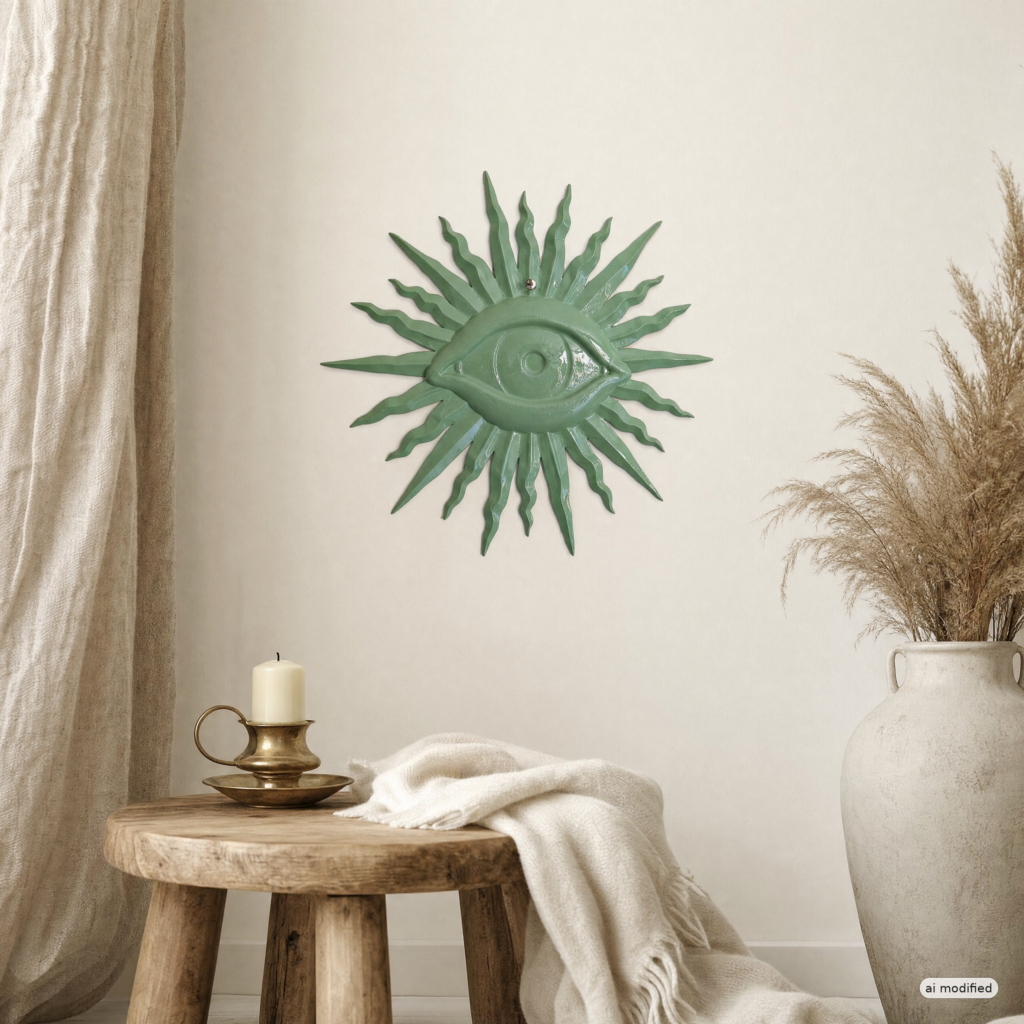
The Green Guardian: Giving Breath to a Wall
When an ancient symbol meets the color of nature, a presence is born capable of transforming an empty wall into a space of protection and emotional regeneration.
There are objects that do not merely decorate. They occupy space with a silent but active presence, like guardians watching over domestic energy. The solar eye is one of them: an ancient iconography that crosses cultures and geographies, from the Mediterranean to the East, always with the same promise of apotropaic protection.
When this symbol dresses in green, however, something different happens. Green is not the color of aggressive defense, but of healing. It is the breath of the forest, the sap that flows invisible yet unstoppable, the silent regeneration that occurs after every winter.
The power of green as an emotional vehicle
Green transforms a traditional amulet into a focal point of balance, bringing the breath of nature into inhabited spaces.
In Mediterranean apotropaic traditions, the protective eye takes on different meanings depending on color. Blue wards off envy, red repels evil. Green, on the other hand, welcomes: it is the color of growth, of returning to center, of rediscovered harmony.
A green solar eye thus becomes a visual anchor that calms the mind even before it protects. Its presence on a wall creates a focal point that draws the gaze and holds it, offering a pause from everyday visual chaos.
- It evokes lush nature and a sense of organic refuge
- It fosters emotional balance without imposing its presence
- It integrates easily with natural materials and neutral palettes
- Brings revitalizing freshness to enclosed spaces
Create visual anchors against clutter
Strategically placing a talisman means building points of emotional respite within the home, places where the gaze can rest and regenerate.
The entrance is the first place of protection. Hanging a green solar eye near the door means creating a symbolic barrier that welcomes those who enter and blesses those who leave. Paired with a trailing plant and a key tray, it becomes the center of a composition that combines practicality and secular spirituality.
In the bedroom, above the headboard, the eye watches over sleep. Green promotes deep rest and regenerative dreams, transforming the wall into a nighttime guardian that protects without disturbing.
In creative spaces – a study corner, a reading nook, a yoga area – this type of decoration acts as a point of return. When the mind wanders or becomes scattered, the gaze can anchor itself to that radial shape, to those undulating sun rays that recall the cyclical movement of nature.
How to position a wall talisman
- Eye level: Never too high. Eye contact must be direct and intimate.
- Breathing space: Avoid overcrowded walls. The talisman needs empty space around it to express its strength.
- Dialogue with light: Place it where natural light can caress the glossy surface, enhancing the relief.
Materials and palette for a harmonious dialogue
A contemporary talisman requires visual companions that respect its organic nature without overpowering its symbolic meaning.
The green wall talisman – made of PLA with glossy coating, dimensions 23 x 23 cm and depth of 1 cm – it naturally converses with raw materials and tactile textures. Untreated wood, woven rattan, glazed ceramic with irregular finishes: these are the ideal companions for an object that combines additive technology (3D printing) and ancient symbolism.
The compatible palettes follow two directions. The first is that of calm: sage green, antique white, sand tones. Perfect for minimalist environments where the solar eye becomes the only wall decorative element, a strong point that does not need to compete.
The second is that of Mediterranean warmth: terracotta, ochre, forest green. Here the talisman fits into a richer composition, conversing with raw linen fabrics, artisanal ceramic vases, brushed brass details that capture the light like little domestic suns.
| Style | Companion materials | Emotional effect |
|---|---|---|
| Boho Chic | Rattan, macramé, plants | Mystical and enveloping |
| Contemporary | Light wood, black metal | Essential and centered |
| Mediterranean Modern | Terracotta, linen, brass | Warm and protective |
Mistakes to avoid: when the talisman loses its power
A powerful symbol can become invisible if placed in the wrong context or surrounded by too much visual noise.
The first mistake is excess. Too many amulets on the same wall create an “esoteric shop” effect that cancels out the individual power of each object. A talisman needs empty space to breathe and to truly be seen.
The second mistake is extreme contrast. Placing a green natural amulet in a hyper-technological or purely industrial environment – steel, exposed concrete, neon lights – without soft elements to bridge the gap means condemning it to emotional invisibility.
The third mistake is position. Hanging it too high, above an imposing piece of furniture, or in a dark corner means depriving it of its main function: to be a daily visual point of contact, a guardian that makes itself seen and recognized.
The glossy finish of the talisman catches the light like water on a leaf. Place it where natural light can enhance the relief of the iris and the sun's rays, turning it into a living element that changes appearance throughout the day.
The return to the center: when the wall becomes an altar
Creating a modern secular altar means selecting a few meaningful objects and arranging them with intention, transforming a domestic corner into a space of regeneration.
You don't need to believe in supernatural forces to recognize the power of symbolic objects. All it takes is the awareness that what surrounds us influences our emotional state, and that a home can be designed not only to function, but also to nourish.
A green sun eye above a console in the entryway, flanked by a candle and a sprig of eucalyptus. A wall corner in the bedroom, with the talisman at the center and two small botanical prints on either side. A focal point in the creative space, where the gaze can return whenever concentration falters.
These are not simple decorative arrangements. They are gestures of care toward oneself, concrete ways to transform the home into an active refuge, capable of protecting not only from external dangers but also from internal noise.
The green of the sun eye is the green of rebirth that happens every day, in silence, without clamor. It is the color that reminds us that after every winter a spring always arrives, and that the truest protection is not the one that repels, but the one that welcomes and regenerates.
Q&A
What is the specific meaning of the green sun eye?
Unlike blue or red, which ward off evil, green symbolizes healing, growth, and regained harmony. It transforms the traditional amulet into a focal point for emotional balance.
Where is it recommended to place the green sun eye in the home?
Ideal locations include the entrance to create a symbolic welcoming barrier, above the headboard in the bedroom to watch over sleep, or creative spaces like study corners and yoga zones.
How does the color green act as protection according to the article?
Green functions as a protective color by evoking lush nature and promoting emotional balance without imposing its presence. It brings regenerating freshness to enclosed spaces, creating an organic refuge.
How can one compose a decoration with the sun eye in the entrance?
In the entrance, the object becomes the centerpiece of a composition when paired with a trailing plant and a key tray. This combines practicality and secular spirituality, creating a breathing space.
What is the function of the sun eye when placed in the bedroom?
Above the headboard, the eye watches over sleep, promoting deep rest and regenerative dreams. The wall thus transforms into a nocturnal guardian that protects without disturbing.