
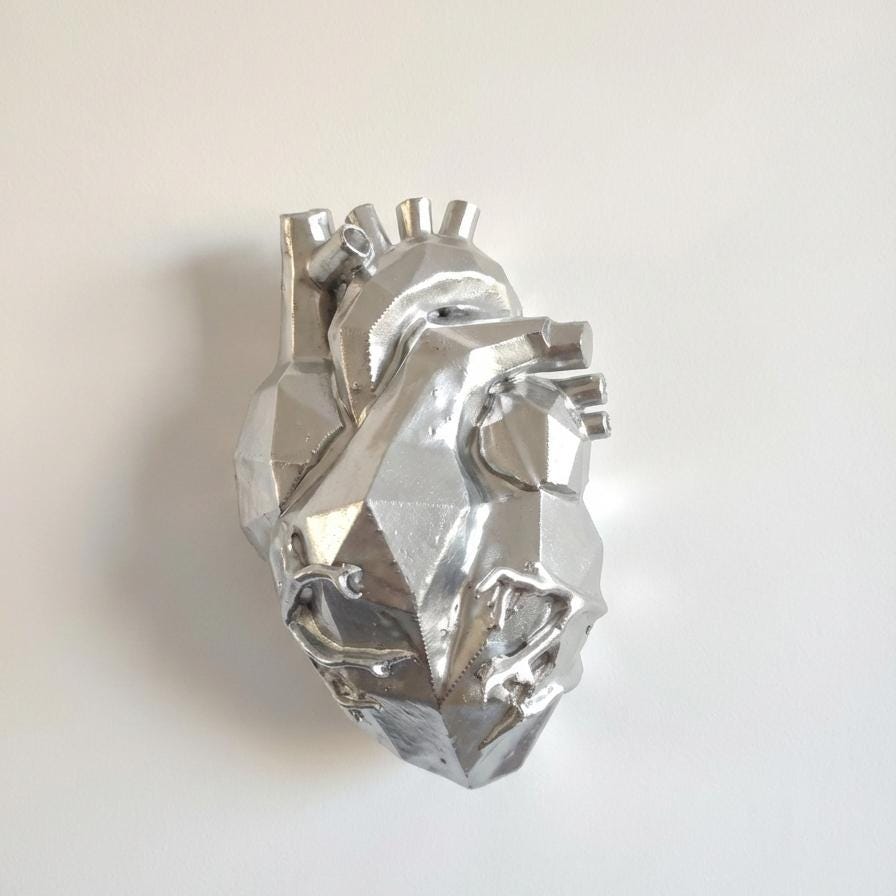
The Silver That Breathes: Integrating an Anatomical Heart into Contemporary Spaces
When precision meets feeling, a visual language is born that speaks of vulnerability without hiding it. The human heart, a universal symbol of emotion, becomes a geometric sculpture through the digital gesture. The silver finish is not a simple aesthetic choice: it is matter that reflects light and gives back space.
The Dialogue of Light with the Silver Surface
Silver does not absorb: it reflects, multiplies, enters into conversation with natural and artificial light, transforming every angle into a different experience.
The silver chromaticity possesses a documented architectural quality. Tato Architects used silver-painted ceilings in the House in Shichiku in Kyoto to amplify the perception of space and capture natural light coming from the skylights. Founder Yo Shimada explained that “the reflective silver ceiling amplifies the ambiguity between the two geometries,” creating a perceptual phenomenon that holds the entire dwelling together.
This principle also lives in small wall sculptures. A silver surface is never static: it welcomes reflections, fragments ambient light, creates depth where there is only relief.
- It welcomes natural brightness without requiring additional artificial sources
- It creates necessary contrast with opaque materials such as concrete and dark wood
- It maintains a chromatic neutrality that dialogues with any palette
- Introduce a technological element without weighing down the view
Anatomy and Geometry: The Body Reinterpreted
The organic shape of the heart is fragmented into flat faces and sharp edges, transforming a vital organ into an object of pure digital geometry.
The anatomical wall heart in silver finish measures 15 cm in height, 11 cm in width, and 7 cm in depth. Its silhouette echoes the real anatomy of the heart organ, but translates it through a low-poly polygonal language reminiscent of three-dimensional renderings.
The process involves 3D printing, preliminary design, enameling, and coloring. The result is a smooth surface marked by horizontal micro-striations, typical of additive layering, completely hidden by the metallic paint.
The sharp-edged geometry fragments light across the surface. Each flat face reflects with different intensity: illuminated areas become bright white, while shadowed ones shift to dark gray. This visual dynamism changes with the viewing angle, making the object alive despite the coldness of the metal.
Strategic Lighting for Metallic Surfaces
Cold light is an ally, warm light is an enemy: color temperature determines the success or failure of a silvered sculpture.
How to correctly illuminate a metal sculpture
- Choose color temperature: LED 4000-5000K (neutral-cool white). Absolutely avoid tungsten bulbs or warm light that flattens the silver.
- Position the source: Directional spotlight from bottom to top or from the side at 45°, never diffuse frontal light that eliminates shadows.
- Control the intensity: Adjustable dimmer to modulate the contrast between illuminated and shadowed areas according to the time of day.
Directional light enhances three-dimensional geometries by creating dramatic shadows. A single well-positioned spotlight transforms the sculpture into a focal point, drawing the eye even in crowded environments.
Compatible Materials and Material-Color Contrasts
The dialogue between opposing surfaces generates balance: smooth versus rough, cold versus warm, reflective versus matte.
The most effective material combinations exploit contrast. Smoked glass and dark mirrors amplify metallic reflections, creating illusory depth. Raw concrete and microcement provide an industrial context that enhances the technological precision of the sculpture.
Brushed steel and aluminum build a monolithic high-tech environment. Dark charred wood (wenge, ebony) anchors the coldness of silver with organic notes. Smooth natural stone such as slate or basalt establishes a dialogue between geology and biology.
| Material | Visual effect | Ideal environment |
|---|---|---|
| Raw concrete | Industrial contrast | Urban loft, creative studio |
| Dark charred wood | Organic anchoring | Contemporary bedroom |
| Smoked glass | Multiplication of Reflections | Minimalist living room |
Color Palettes for Futuristic Environments
Cool white, pearl gray, and matte black create a clinical and minimalist effect that enhances the precision of the anatomical form.
The chromatic neutrality of silver allows for bold combinations. A palette of industrial grays with anthracite and small burgundy red accents evokes blood without becoming banal. Midnight blue and petrol blue with silvery touches build cyberpunk atmospheres.
Neutral cement tones with purple or cyan neon details introduce sci-fi lighting. Cool earthy tones such as ash gray and dark sage green temper the technology with natural references, creating a balance between artifice and the organic.
Placement and Composition in Living Spaces
The silvered anatomical heart it is suitable for a bedroom, kitchen, living room, creative space, and office according to contemporary style.
In a creative studio or home office, it works as a reminder of rational passion. In a contemporary living room, it finds a place above a minimalist console, becoming a conversational focal point. In an urban loft bedroom, it can replace the traditional headboard.
The gaming area or home theater room perfectly accommodates the science-fiction aesthetic. The entrance, illuminated by directional spotlights, transforms the sculpture into a provocative work of art that welcomes guests.
Do not position it too high or outside the direct field of view. The sculpture requires close observation to appreciate the anatomical details and the interplay of light on the polygonal faces.
Gallery Wall Compositions and Symbolic Pairings
A silver anatomical heart can become the gravitational center of a narrative wall that blends science, art, and personal symbolism.
Placing it at the center of a gallery of black square frames creates a three-dimensional “painting” that emerges from the surrounding two-dimensionality. Pairing it with succulents or suspended tillandsias creates a strong contrast between living nature and inert metal.
Visually suspending it against exposed bricks painted white or dark gray builds a dialogue between industrial texture and glossy finish. A composition with distorted mirrors and geometric art amplifies the speculative dimension of technological anatomy.
Avoid shabby chic, country, or overly romantic settings: the silvery anatomy clashes with lace and light lacquered wood. Do not crowd it with other similar 3D sculptures: the sculpture needs breathing room and empty space to assert itself.
When Metal Warms Emotion
Contradiction is the heart of contemporary design. A vital organ rendered in cold metal becomes more powerful than any romantic representation. Digital precision does not erase emotion: it concentrates it, distills it, and makes it universal.
Silver reflects whoever looks at it. In this sense, a metal anatomical sculpture is always autobiographical: it speaks of those who have chosen to expose their vulnerability through the armor of technology.
Q&A
What are the exact dimensions of the silver anatomical heart?
The sculpture measures 15 cm in height, 11 cm in width, and 7 cm in depth. These dimensions make it ideal as a wall decor element without occupying too much visual space.
How is the silvered surface of the anatomical heart created?
The object originates from a 3D print followed by preliminary drawing, enameling, and metallic coloring. The painting hides the micro-striations of additive layering, creating a smooth and reflective finish.
Why is silver recommended for contemporary spaces?
Silver amplifies natural brightness and creates contrast with opaque materials like concrete or dark wood. Its chromatic neutrality dialogues with any palette while maintaining a light technological appearance.
How does low-poly geometry influence light perception?
The fragmentation into flat faces and sharp edges causes every angle to reflect light with varying intensity. This dynamism transforms the surface from bright white to dark gray as the viewing angle changes.
Which architectural principle inspires the use of silver in this project?
The design is based on the principle seen in Tato Architects' House in Shichiku, where reflective silver amplifies spatial perception and captures natural light. The goal is to create a perceptual phenomenon that unifies the environment.